
A few days into our August vacation to Cape Breton, where there was already a complete fire ban due to extremely dry tinderbox conditions, the province of Nova Scotia declared a province wide ban on going into the woods, into the wilderness, including any hiking. No Skyline Trail for me, or any other trails in this hiking dreamland. This was interrupting our plans. Now I knew I would be okay. Get over it. It was really a small thing in comparison to a forest on the edge of potential disaster. There are lots of other wonderful things to do in Cape Breton and I had done a few hikes already and quickly did the tough Acadian Trail right from our Chéticamp campground that evening before the ban came in. But it was strange seeing all these markers and barriers at the edges of all the trails, the edge of the wilderness, declaring the danger of being in the wilderness. It made me wonder where does the forest start and end. It can be a blurry line.
I started seeing edges all over the place. We stayed a few days at Five Islands Provincial Park on the Minas Basin of the Bay of Fundy, with the highest tides in the world – 17 meters. So we watched and explored at low tide and high tide, with the edge of the water a moving target, always shifting drastically in and out. We were warned to stay a bus length away from the edges of the majestic 90-meter cliffs – on top or below, because that edge can suddenly break and drop off at any point. And then there were the stunning sunsets over the water, where it seemed to take forever for the sun to set, but once it got close to the edge of the horizon, it seemed to speed up and disappear in an instant.
Edges are strange things. We talk about the sharp edge of a knife or a double edge sword or a line with very clear boundaries. We talk about getting the completive edge over something, or being on the cutting edge, or sitting on the edge of my seat because something is so riveting. Don’t push me off the edge. She has razor edge focus. But edges can also be fuzzy, with a lack of definition, a little bit like that sunset on the horizon or the waters of a tide beach. It is a softer edge, flexible, moving. We talk about someone being a little rough around the edges. Or we take an aspirin to take the edge off of a headache. Or we just feel kind of on edge about something. It’s more vague, diffuse, the boundaries not so clear.
In either case, it feels like it is on the edge of things where the action happens. We need to keep on our toes. We ask questions when we are on edge? We search for meaning and definition and clarity? We want to know the boundaries of what is possible or not, acceptable or not? It is where life takes on focus and change and renewal is possible. Like being near the cliff’s edge, we have left the safety of the centre and what we know, and ventured out to see a world much bigger than we thought possible, that may bring us danger, but also adventure and new life. Could it be that God is most likely to show up on the edges of our lives? Maybe it is okay to stop on the edge of the wilderness and take stock about the dangers and opportunities that may lie ahead.
Our biblical story this morning is all about edges and the life, discovery, healing and transformation that can happen on the edges of our lives. It is also a story within a story. A perfectly good healing story of Jesus with Jairus and his daughter is interrupted by this woman on the edge, and the two stories interact and inform each other in some interesting ways. May this story help us look at the edges of our own lives.
So, we need to begin with the first story. Jesus has crossed the sea again in a boat, and is greeted by a big crowd. Into the crowd comes Jairus, one of the leaders of the Synagogue. He is distraught and falls to his knees in front of Jesus. His 12-year-old daughter is on the edge of death. He pleads for Jesus to lay his hands on her and make her well again. The story starts in the centre, with Jairus. He is named. He is known. He is a leader. He carries respect and authority and trust and status in the community. There would have been huge sympathy and concern for Jairus in this situation. Part of that is the love and respect his community would have had for him, but I think part of that is also because each of us knows that deep down, no matter how solid and centred and stable and secure our lives may appear to be, they can be instantly flipped upside-down and we find ourselves on life’s edge, desperate and scared. An illness, a death, a job loss, a betrayal, a natural disaster, a political upheaval, our own human messing up. We are de-centred and pushed to the edges in all our human vulnerabilities. Jairus’ beloved daughter, ‘my little daughter,’ is about to die and he grasps for Jesus, falling on his feet. He is suddenly in the wilderness.
It is with Jesus and Jairus and the whole crowd on the way to see this dying daughter, that our story gets interrupted by a woman who has been suffering from a flow of blood for 12 years – note the 12 years again. This woman is un-named, un-known and not of status. She is on the edge and margins of society. She has known the wilderness for a long time. This is often listed and told as the story of the hemorrhaging woman or the bleeding woman. As Joanna Harader writes, ‘the woman in this story is known by her circumstance rather than her name.’ (Prone to Wander, Herald Press, 2025, p. 135). As she writes about the woman caught in adultery, or other characters in this particular chapter on ‘Women Who Encounter Jesus’, there are other names we could have given her. ‘The woman who loved children. The woman with a beautiful voice. The woman who was wounded.’ (Ibid, p.132) She is defined by the flow of blood. It is non-stop. It dominates her life – physically and emotionally. It has made her desperate. She has endured much under many physicians and spent all her money and resources. But in a society that did not have healthy ways of talking about women’s health and saw even regular, natural menstruation as something that made you unclean, the burden of this illness was even greater. She had been living in a state of supposed ritual impurity for 12 years – which meant not being allowed to participate in religious practices, or enter holy places, or even touch others who would fear become religiously unclean themselves. This would have been a wilderness experience and she too is desperate.
So what does she do? She interrupts Jesus, she comes up from behind in the crowd and touches the hem of his garment, the edge of his cloak – ‘If I but touch his cloak, I will be made well.’ Remember, her touch was seen as making one unclean. That took courage and guts! It took initiative. It took the risk of imposition – of imposing on Jesus himself. And immediately two things happened. Her flow of blood stopped, and Jesus became keenly aware that power had gone forth from him. The woman would have loved to simply disappear quietly, but Jesus looks around and asks ‘who touched me?’ The woman is full of fear and trembling. To be made public. She too falls down on her knees before Jesus, vulnerable and exposed, and as the text says ‘told him the whole truth,’ tells her story, from the very edges of her world. Jesus responds with a word, a name, we have already heard in the passage. ‘Daughter… Daughter, your faith has made you well; go in peace, healed of your disease.’ No shame, no lingering questions, but rather welcome, belonging, healing, love – brought from the edges to the centre. We are not told how the crowd responds to this woman and this healing. Were they irritated by this interruption of Jesus, by this delay in getting to a girl who was dying from a prominent family? Did they fret over her uncleanness or being associated with someone so on the edge? Or did their hearts open with compassion as they had with Jairus, and as they witnessed this miracle of healing and acceptance, from the edges to the centre?
We did not read the rest of the text in Mark 5, but the story returns to Jairus and his daughter. She has now died and the scene moves to the weeping and wailing outside the home of Jairus. Jesus takes the girls hands, and says ‘Little girl, get up!,’ to which she stands up and begins to walk about – a second healing, with amazement all around.
I am struck in these two stories, so very different, and yet so the same, that both Jairus and the woman, despite very different starting points, find themselves teetering on the very edge of human desperation. One comes from the centre of society and one comes from the edges of society. But both find themselves in a place of wilderness, to which Jesus provides healing, raising them up. And both have the courage from that place of desperation to reach out to Jesus. Harader takes the title of this chapter from the Come, Thou Fount hymn phrase (VT 563) – ‘when a stranger.’ When one is estranged, on the edge, feeling like a stranger, the healing of Jesus is there. The full quote is from that second verse is: ‘Jesus sought me when a stranger, wand’ring from the fold of God. He, to rescue me from danger, interposed his precious blood.’ (verse 2). We could add that sometimes we are the one who see out Jesus, if we have the courage, and maybe also the desperation and the vulnerability of the woman or Jairus.
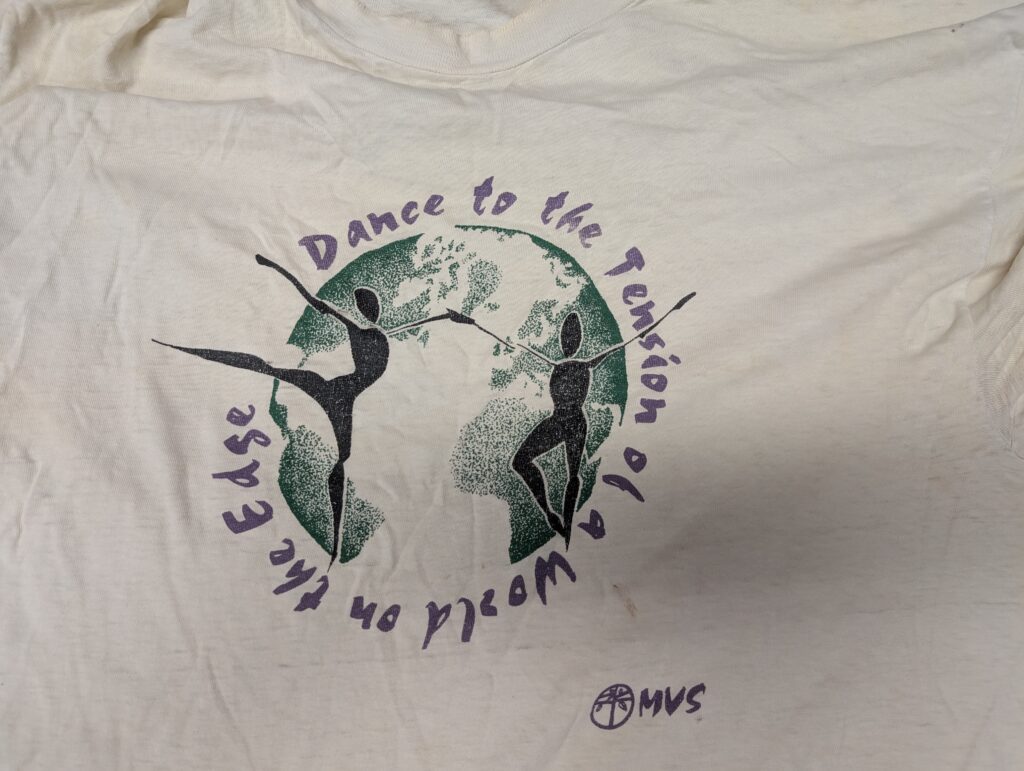
When I was a young adult, just finished undergrad, I spent two years with Mennonite Voluntary Service, MVS, in the low-income north end of Hamilton at Welcome Inn Community Centre and Church. This is where Rachel and I met. It was in that setting where I first came face to face with people living on the very edges of society and survival. I also saw the courage and persistence so many times of folks reaching out, advocating for themselves, finding resources, finding healing, making themselves known from those very edges. I also recognized and become more in touch with my own vulnerabilities, some of my own wildernesses of trying to figure out my identity, how I fit into the world and what my calling in life might be. The motto of Welcome Inn at that time was ‘Meet Your Friends Here’, a place where strangers could become friends, where whatever the edge of the wilderness was for you, you could find a place of refuge and friendship and support – and mutual making of community.
During those Voluntary Service years, MVS came out with a t-shirt. I somehow found it still tucked away into an unused drawer under our bed. (Pull out t-shirt, but also project image on the screen). It has an image of the globe with two figures just touching the edges of their fingers to each other and dancing, with the phrase ‘Dance to the tension of a world on the edge.’ I took that phrase to heart. So much of our world is on edge – the edge of poverty, the edge of violence and destruction, the edge of wars – some that go on and on, the edge of starvation for the people of Gaza, the edge of political sanity, the edge of a loss of democracy, the edge of trust in reliable media, the edge of an era of shared values and established norms of behaviour, the edge of environmental disaster, the edge of mental health, the edge of faith and what we believe, and there are so many other edges we could name in our world and in our own lives. Sometimes those edges are sharp and clear cut, and sometimes they are very fuzzy and flexible and undefined. There is tension there. A world on the edge. But we are invited to dance within that tension. To know that it is in that very tension of a world on the edge that change is possible, that hope emerges, that healing can happen. The edge is where the action happens. Our story today reminds us that Jesus is present on the edges, in the wilderness, from however we have found ourselves on the edge, strangers becoming friends, healing emerging when all hope has been lost, the unnamed being called and named ‘daughter. son. child. Friend. beloved.’ Let us have the courage to fall down on our knees, to reach out to the hem of the garment, to wander in the wilderness, as we have been doing all summer. Let us dance to the tension of a world on the edge. And may we find Jesus there. Amen.