

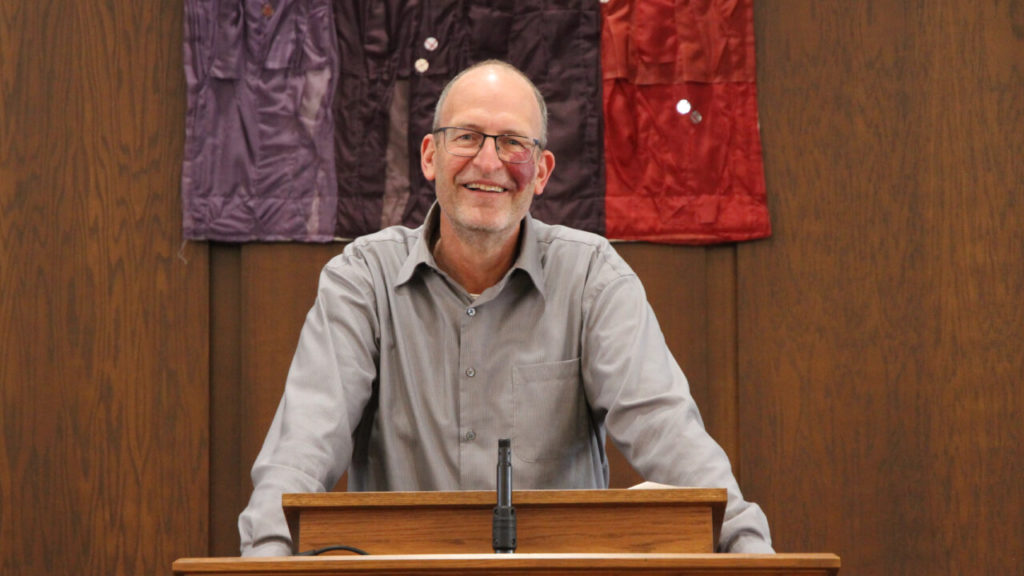
This morning is our Epiphany Sunday here at SJMC, the last Sunday of our Advent-Christmas Worship series on ‘Great Expectations.’ Epiphany celebrates the visit of the Magi, or Wiseman to see baby Jesus. Tradition would place it one Sunday later, on the Sunday closest to January 6th, but today is when it made sense to complete the arc of this worship season. Now it feels like I have almost always ended up being the pastor to preach on Epiphany Sunday and preach about the Magi. It is usually because the previous Sunday I have been with our family in Bluffton, Ohio for our Diller Christmas, which was the case again this year. Now I am not complaining. I love this story. It is so rich with meaning, and like so many Biblical stories, each time you enter into them, there are new insights and new ways the Scripture speaks to an ever-changing world and our own new situation.
If I think back to all these Epiphany sermons, one of the things I have tried to do is separate out the story of the Magi in Matthew from the rest of the Christmas characters that are found in Luke – the Angels and Shepherds and that whole night scene around the manger because there was no room at the Inn.
I’ve talked about the Nativity creche as a disservice to the two distinct gospel writers because it puts the little Shepherd and Wiseman characters right beside each other at the manger. There are no Magi in the Luke account, and Matthew only talks about the Magi and Herod and the later flight to Egypt. Luke is the immediate story of the birth of Jesus, and the Matthew story may have happened up to two years later. After all, Herod has all baby boys killed who were two years old and younger. The unique and individual ways both Luke and Matthew tell their Jesus birth stories sets up the focus and themes and expectations of the rest of their gospels, and it is important that we hear those two different voices. They each have their own message. I have so enjoyed explored the unique message from Matthew on past Epiphany Sundays.
Well, today that all gets thrown out the window, since our worship series has put both stories back together again. We just heard both the Luke Shepherd story and the Mathew Magi story. On the same Sunday, in the same worship service. And I realized how excited I got to see them put together again – not because we are crassly fusing two gospels together, but because each story can stand in contrast to and comment on the other story, and in the end give us a fuller account and understanding of the meaning of the birth of Jesus. Perhaps there is one characters that you identify with more than the other. Or one vantage point that provides insight into the other. What can we learn when we tell and explore both stories, when we focus on both the Shepherds and the Magi together? This could be fun!
The thing that strikes me most when I put these two stories and these two sets of characters beside each other is how contrasting they are. The Shepherds are common people. Poor, uneducated, mundane, untravelled, very local, naive. Doing the work no one else will do. We sometimes call them the lowly Shepherds. What did they know about how the broader world worked? The Magi are something special. Rich, educated, mysterious, well travelled, globally-minded, sophisticated, with the means to explore the world and this star and what it might mean. What expectations did they each carry? Did the Shepherds live life with no expectations, able to accept and take in whatever came their way? Did the Magi live life full of great expectations, not knowing how they could ever be fulfilled?
With the Shepherds, there is an immediacy to the story. Their emotions are all over the map – from terrified to amazement and joy, to deep gratitude. The angels appear and immediately they rush off to Bethlehem with haste to see this thing that has taken place, and then become the first witnesses, glorifying and praising God. They don’t need to study the question and analyse. They just jump right in. Are they more open to the divine? Open to following the Spirit? Spontaneous? Unencumbered? There is much we can learn from the Shepherds.
With the Magi, the story is much more drawn out and measured, maybe over months and even years. They study the stars. The gather evidence. They are thorough and systematic. And yet they are dreamers, willing to follow this star, no matter where it might lead, no matter the cost. The story is also much more complicated and political. They have to navigate King Herod, this power-hungry tyrant – this vassal king for Rome, what Diana Butler Bass calls a ‘rump king’ – non-Jewish, holding on to power, willing to kill and murder his own wife and several of his children, and to gain reputation with the people and look good – re-building the Temple and initiating massive public works, as Butler Bass comments’ like putting up a new ballroom in the palace.’ (https://www.youtube.com/watch?v=5oJeFqrFViQ&t=2s) In this story it is King Herod who is the one afraid – paranoid – willing to go to violent extremes to maintain his power and position. The Magi manage to navigate all of this and see through Herod. It is risky, but they return home by another road. Notice how they get their ‘angel visit’ too, their warning in a dream. The Magi are willing to sacrifice all to find the answer to the mystery of this star, to journey and find this child who has been born king of the Jews. There is much we can learn from the Magi.
So the Shepherds and Magi are definitely contrasting characters. And yet, when you start to put the stories beside each other, put the characters in the same creche, you start to see some parallels, that they both belong right there with the Christ Child. The first thing I notice about both stories, both sets of characters, is that they are filled with awe and wonder and are transformed by this baby that they know will change the world. The Shepherds literally run with haste to find this baby promised by the angels, and they are transformed from lowly Shepherds to the first amazed and joyful and exuberant witnesses to this birth – the first evangelists, spreading the good news! The Magi too, are overwhelmed by meeting Jesus – overwhelmed by joy, and bringing them to their knees in worship and paying homage. They share their gifts. They are brought to the core of meaning and significance. They change their plans, their lives forever changed. Awe, Worship, Joy, Transformation, New Life – these are shared by all.
The other commonality is that both these sets of characters are outsiders, somehow on the edges of society. The Shepherds because of their lowly jobs and lack of income. The Magi because they are foreigners, not from around here. They both experience that sense of being on the outside looking in. And yet, in the manger, with the Christ Child, they are drawn right to the very centre. I sometimes wonder if most people, no matter what their social status and situation feel themselves on the outside – even those who we might hold with high regard and think of as insiders. It always feels like you are on the outside of something. I remember at a board and elders retreat in a previous congregation, each person, each leader, expressing that they felt somehow on the outside of the congregation. This all changes with the Christ Child. With Jesus, there are no insiders and outsides. All are welcome.
I wonder if the key to both stories is found in the message of the angels. ‘Do not be afraid, for see, I am bringing you good news of great joy for All the people… for All the People.’ It doesn’t matter what your background is, what part of society you come from, your personality, whether you feel lowly or not, insider or outsider, your life situation and context – the good news of the birth of Jesus is for All the people, for everyone. Everyone is welcome at the manger. Everyone is welcome to approach Jesus and experience that awe, wonder joy and transformation. What might that mean in our lives and our world today?
There are two examples of this I want to share. One wonderful instance to me came out of our Beyond Sunday morning Ministry a few Sundays ago. We invited David Alton, from the Social Development Centre in Kitchener, to share with us on a Sunday evening about homelessness in Waterloo Region. The video link was in our last newsletter. David is a fascinating person. He leads the Lived Experience Engagement Program, working to bring together people experiencing homelessness with government leaders and staff, hoping to create a safe space of conversation and understanding. Can such a diverse group actually come together? Sounds like the diversity at the manger? David shared how he had to throw out all his group process training and its sticky notes – it just didn’t work to cross such economic and social bounds with the tremendous difference in power. His goal has been to give each person a voice – to even the playing field. It all starts with very careful listening, and creating environments where every voice can be heard. It doesn’t always work, but David has slowly built trust with people in the encampments, with counsellors at city hall, with developers, with city staff and so on. He is a bridge builder. People of all backgrounds trust him. He told one story of the big garbage dumpsters that needed to be moved to a new location on the site of the Victoria Street Encampment. There was much turmoil, and then careful listening to all sides, all voices. After much negotiations there was an agreed upon new location, but David knew that before that could happen, there still needed to be a public forum where all sides simply needed the time to yell and complain to each other, to express their overall frustrations, and really for everyone to be given a forum to talk, to have their voice heard, including those living at the encampments. That went on for 2 hours, and David didn’t intervene but simply let it happen. When it was all done, the dumpsters got moved to their new location without a fuss, as previously negotiated, and life went on. David voiced that the value above all for him, is to treat every single person he meets and interacts with, no matter what their social status or place in life, with full respect, fully seen and valued, as a fellow child of God. Isn’t this a story good news for all people.
A second story that reminded me that the manger is for all people came from a recent CBC radio 1 story on the Current from Friday, December 12 (https://www.cbc.ca/radio/thecurrent/friday-december-12-2025-episode-transcript-9.7014193) . Matt Galloway interviewed Mark Bittman, famous as a writer for the New York Times and his bestselling cookbook ‘How to Cook Everything’, encouraging people to skip takeout and cook real food at home. Mark Bittman has a new pilot project – a very different kind of restaurant called ‘Community Kitchen’ in New York City. He recognized that many people do eat out much of the time. So he wanted to demonstrate what good food was, when you source from local farms, pay workers well and hire a great chef who cooks terrific nutritious food. But then he added something radical. They have a fixed menu each day, but people pay on a sliding scale – either $15 or $45 or $125, based on your income, which they don’t ask about. It’s all done on the honour system, and their experience is that people are honest and follow the three tiers. At first, the people coming were mostly, as he says ‘well healed white people.’ But they intentionally connected with various partner agencies in the community, and created a safe and welcoming space, and now a typical evening has about a third of the people from each income level – and it works. There is this sense of a very diverse community coming together to eat good food together. There is joy and wonder and transformed community. They have achieved their goal, as he says, ‘to have a mix of people from the neighbourhood, people from out of the neighbourhood, people with lots of money, people with not lots of money, people of all backgrounds, incomes, races, geographical location, etc.’ Isn’t this a story of good news for all people?
What other good news stories are there in your life, in your community, in our world? There are so many. To me they illustrate and embody what we find at the manger – that this is good news of great joy for all people! The Shepherds and the Magi both belong and are welcome at the manger. So is each of you. So are the wide diversity of people, no matter what their background, race, age, gender experience, sexuality, income level, disability, limitations and gifts, life situation. All are welcome at the manger, with the Christ Child. Today we lit the Christ Candle. In lighting that Christ candle we commit ourselves to deep listening, to offering respect to all -seeing and valuing all as Beloved Children of God – including the Shepherds and the Magi. ‘Do not be afraid, for see, I am bringing you good news of great joy for all the people: to you is born this day in the city of David a Savior, which is the Messiah, the Lord. This will be a sign to you: you will find the child wrapped in bands of cloth and lying in a manger. And suddenly there was the angel a multitude of the heavenly host, praising God and saying: Glory to God in the highest heaven, and on earth peace.’ May it be so. Thanks be to God. Amen.