

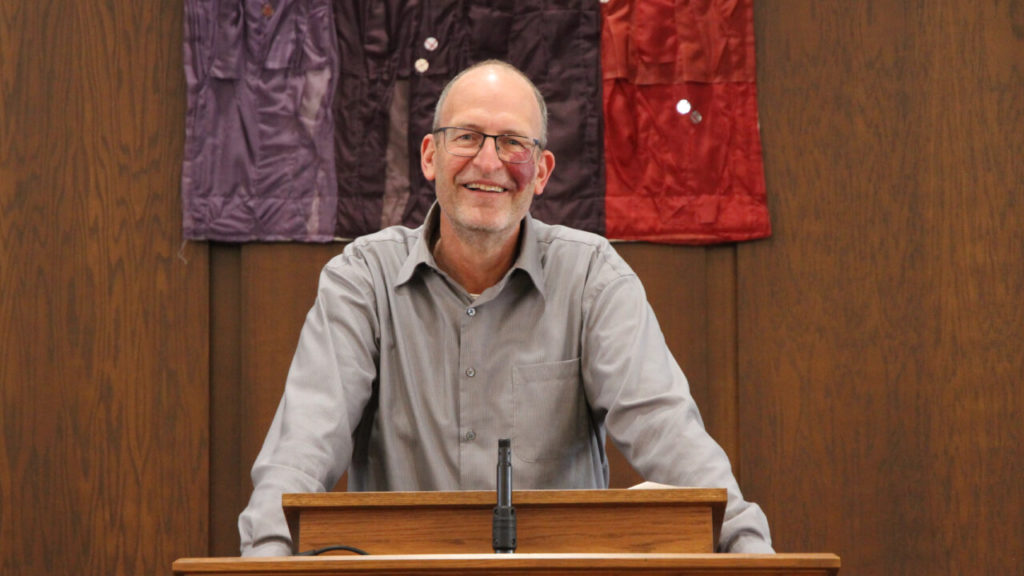
Mark: Well Chuck, we did it. We pulled off a pretty good little Biblical drama there during Experiencing the Story (give high fives)
Chuck: That’s for sure. I must say, we are excellent stage directors. I think the congregation really liked what they saw. Well done!
Mark: Yah, how we divided people up between the disciples and the crowd, and got Jesus up on that mountain. And used props and costumes. We’re good.
Chuck: The Jesus character was awesome. All that stuff about being poor in spirit and meek and pure in heart – all that humble stuff. He rocked it!
Mark: I like how he ended things. Talking about both salt and light.
Chuck: Yah, that’s the part I think I understood. I know how much salt can bring out the taste in things, and how even a little bit of light brightens up everything so you can actually see. So we are to bring salt to the world and light to the world, and to do so through good works, through how we live our lives.
Mark: That makes sense to me too. This passage is a real challenge to how we live out our faith. Just like Jesus said.
Chuck: Yup…now what exactly was is it Jesus said again? He kept talking about blessings, but he seemed to speak in riddles. I am not sure I actually quite caught what he meant. (sit down on the two stools)
Mark: Come to think about it, neither did I. It kind of went by pretty quick, and it didn’t always make sense to me, or what I expected blessings to look like. I wish I could hear them again and slow it down, to really think about each one.
Chuck: Maybe we can do that… We record our services, don’t we? (looks to the sound booth). Hey Larry, can you help Mark and I out here? Is there a way you could re-wind the drama that just happened, and play us parts of the audio? We want to hear each of the Beatitudes, one at a time.
Larry: Sure, I can do that. We have the technology. Just give me a second. (plays rewind sound). I think it is all cued up, and ready to go.
Mark: Let’s start at the very beginning, with the first one
Jesus: (Devin, as Jesus, is in the sound booth and speaks each line from a mic there) Blessed are the poor in spirit, for theirs is the kingdom of heaven.
Chuck: See. I don’t get what that means. Who are the poor in spirit? Is it about poverty – those people who are materially poor in our world… but that would mean telling them to just be patient and wait until they get to heaven. I don’t like that. Or is it about not having enough spirit? Somehow not always ‘getting it’ spiritually, and feeling bad about yourself – that you don’t understand the Spirit or the Bible or faith. Many of us can identify with that.
Mark: I find it interesting that in Luke’s version of the Sermon on the Mount in Luke 6, Jesus says ‘Blessed are you who are poor.’ It doesn’t add ‘in spirit.’ So maybe this passage should encourage us to pay attention to the poor, and do something about it. There is much to learn there. But I also wonder if ‘poor in spirit’ might be about our attitudes and dispositions. The Believer’s Church Bible Commentary comments ‘The poor in spirit now, as then, are ultimately those standing without pretence before God, stripped of all self-sufficiency, self-security, and self-righteousness.’ (Matthew, Richard Gardner, Herald Press, 1991, p.94)
Chuck: You mean ‘Those not too proud to acknowledge their dependence on God.’ We often feel inadequate in the search for meaning and understanding. It is encouraging to think that God is giving us permission to acknowledge our lack of understanding about spiritual matters to God and even to ourselves. (https://letthetruthcomeoutblog.wordpress.com/2021/04/01/the-beatitudes-a-hebraic-perspective/)
So these are all really ‘Be-Attitudes.’ And if Jesus ends with Salt and Light, attitudes that lead to action – to good works, that makes a difference. Action coming authentically out of our being.
Mark: Matthew talks a lot about the kingdom of heaven. Sometimes the kingdom is here and now, sometimes yet to come. He ends this first Beatitude with the kingdom of heaven. Again I like the quote from the commentary that ‘Blessedness consists in knowing that one will be part of the new order.’ (Ibid, p. 90). Jesus has started something here on earth, a way of being in the world, that is, well, heavenly.
Chuck: I think we’re getting somewhere.
Jesus: 4 “Blessed are those who mourn, for they will be comforted.
Mark: Now this is one I think I understand. We use this at funerals and when people are suffering. It sounds so straightforward, but I wonder if there is more underneath.
Chuck: I think first about the faith community, and how we comfort one another in difficult times, when people are mourning – a death, a loss, a tragedy. We come together and offer prayers, hugs, casseroles.
Mark: Maybe part of this, is admitting that we are weak, and fallible human beings – we can’t do it alone, we will face pain. We will fall short.
Chuck: Yes. There is so much messaging right now that you need to be strong, powerful, tough. Empathy is a bad word. This beatitude counters all that.
Mark: Maybe part of our mourning right now, is not just personal suffering or losses, but mourning the condition of our world as it now exists. This is communal, not just personal. I pray that God comforts us.
Jesus: 5 “Blessed are the meek, for they will inherit the earth.
Chuck: Ok, this one seems to follow naturally from the last two. I’ve always worried that being meek just means you are a pushover and don’t stand up for yourself. But maybe it is about our attitude towards power and choosing not to bully or dominate others. It is respecting others, sharing, being collaborative, and not having to always get your way – a way of life really.
Mark: for they will inherit the earth, not just heaven. This isn’t just ‘pie in the sky’ – these kingdom values are about our life here. So heaven on earth?
Chuck: Maybe we shouldn’t have been so gung ho on how well we directed the drama! That wasn’t very meek of us.
Jesus: 6 “Blessed are those who hunger and thirst for righteousness, for they will be filled.
Chuck: Growing up, I always thought about righteousness as having to do solely with our relationship with God – being right with God. Very pietistic. Also very personal, but its dark side led to being judgemental of others as not measuring up to this righteousness, not being holy enough.
Mark: So often in the Old Testament, righteousness is paired directly with justice. So what might it mean to hunger and thirst for a world that is just and fair? This sounds as much communal as personal. Maybe that is what a right relationship with God means? Being filled then, has to do with the bigger world out there.
Chuck: So ‘full-filled’ rather than being ‘full of yourself’.
Mark: Right!
Jesus: 7 “Blessed are the merciful, for they will receive mercy.
Mark: This is a hard one. I am all for being merciful, forgiving, gracious. But what about those places where there has been injustice? Where there has been injury and offense. Do people get off Scott-free? What about accountability?
Chuck: I remember how hard this was as a parent. Your kids would do something wrong and for their own sake, they needed consequences, even as we loved them unconditionally. I remember years later, my son Nathan doing a legal study term in West Africa as they dealt with child soldiers who had been forced to do terrible things. Those child soldiers themselves, after the conflicts, wanted some form of punishment, some consequences, for them to feel like they could be fully re-welcomed then back into the community. So maybe this is what mercy sometimes looks like.
Jesus: 8 “Blessed are the pure in heart, for they will see God.
Mark: I stumble on that word ‘pure.’ If I look at Mennonite history, we have sometimes emphasized purity so much, that so many people were judged as not measuring up, not being pure and holy enough and it became a form of exclusion.
Chuck: Does it make a difference that it says ‘pure in heart’, and that it has to do with seeing God. The word heart is, perhaps, as important as pure. Maybe being pure in heart is about an attitude that looks for the best in others, and sees the face of God in other people. I like that.
Mark: The Believers Church Bible Commentary suggested ‘integrity’ as a word for ‘purity.’ (Ibid, p.96) – which moves in the direction you are suggesting Chuck. Maybe integrity is more important than some sort of perfectionism – it is about having good motives in our relationships and life choices, even if we don’t always get it right.
Chuck: I like that. That’s a whole new look at purity. When our actions stem from motives that are selfless and honest, we are blessed.
Jesus: 9 “Blessed are the peacemakers, for they will be called children of God.
Chuck: Is this a Mennonite beatitude?
Mark: Yes, peace has been so important to Mennonites. But often peace has taken the form of non-resistance or non-participation in war – and led to a kind of quiet in the land. When I hear this now, it sounds much more active – not just being peaceful, but actually being peace-makers – looking for places where there is no peace and trying to do something about it.
Chuck: What might that mean in a world that seems so violent right now, with increased militarism? What does it mean for Gaza, Ukraine, Venezuela? Minneapolis? And what might it mean for much more local situations of violence? Domestic violence? Racism? A system that leaves some homeless and helpless?
Mark: Is that phrase ‘children of God’ like ‘seeing God’ that calls us to see the other, even the enemy as a child of God, as valued by God, as beloved by God. Maybe that is where peace-making starts.
Jesus: 10 “Blessed are those who are persecuted for the sake of righteousness, for theirs is the kingdom of heaven. 11 “Blessed are you when people revile you and persecute you and utter all kinds of evil against you falsely on my account. 12 Rejoice and be glad, for your reward is great in heaven, for in the same way they persecuted the prophets who were before you.
Mark: I wonder what these verses sounded like to the original disciples, those early Christians who often did face persecution and a hostile response to living the kingdom values of Jesus? Again we hear about the kingdom of heaven, and reward, and rejoicing and being glad. What did that mean? While we do have an earlier history of times of persecution, we live a pretty safe and easy life right now. Can we relate to these last beatitudes?
Chuck: There is this twisted logic right now that sees Christianity, sometimes named as ‘White Christianity’ as being under attack within North America, and uses that fear to discriminate against other religions or support anti-immigration. I don’t think that’s what this is about.
Mark: Maybe there is a word in here for us in a changing world that is feeling more unpredictable. If we truly lived the rest of the Beatitudes we have just heard – to be peace-makers, to hunger and thirst for righteousness, justice, truth telling, integrity, to be meek and poor in spirit for the sake of our world – all of which challenges the powerful. If we truly were more salty and shone that light more. If our attitudes were truly springboards to action. Maybe then, we would start facing opposition, false accusations, condemnation, and scorn. What might The Beatitudes be calling us to? Are the Beatitudes preparing us for something?
Chuck: There is a calling here, not just to each of us as individuals, but to us a church, as a community of faith, to live into God’s kingdom – into that promise of a new order, that way of Jesus – something already here, but not yet fulfilled.
Mark: Thanks Larry for rewinding and slowing this all down for us.
Chuck: Yes, it was good to hear each of the Beatitudes on their own. But really, when you do that, you realize how much they all connect to each other. Each one strengthens the next, and they build as a whole. Each attitude leads to action that is blessed. No wonder Jesus follows them with this metaphor of being salt and light in our world.
Mark: In that first hymn we sang this morning, ‘Could It Be That God Is Singing’, it kept talking about the idea of cadence. ‘Surely mercy has a cadence, I can feel it in my soul.’ (VT 42, v. 1) Cadence is a musical term for how the chords in a phrase of music resolve, or the rhythm of sound, but we also use it to talk about how ideas echo, or build on each other. Maybe that is what is going on in the Beatitudes?
Chuck: I like that – there is a cadence to each of the single beatitudes that gives overall shape to what the kingdom of God looks like and how we can participate in that new order, how God’s blessings can abound. ‘May I, too, live bold resistance to injustice, hate, and force. Surely peace, it has a cadence, asking all of what we bring! And if music is God’s breathing, take a holy breath and sing.’ (VT 42, v.3)
Mark: May it be so!
Chuck: Amen! (both walk off the stage)