

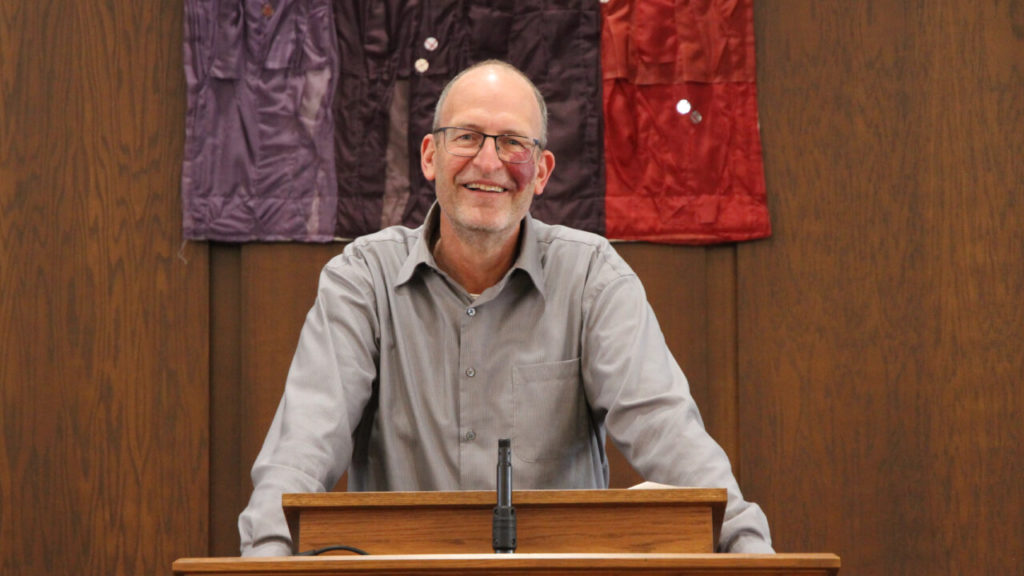
Dialogue #1 – Mark Diller Harder and Don Penner
(Mark and Don go up on stage and sit on two stools. Have a dialogue)
Mark: So Don, this service and the Scriptures we are using evolved in a different way that I had first imagined – maybe a bit like this whole peace series that we have just launched – It keeps springing up and surprising us. It feels so led by the Spirit!
Don: The Spirit certainly is leading us! What had you imagined for this Sunday?
Mark: What I had first suggested to you was that we find a bunch of Old Testament and New Testament Scriptures about peace and share them as a Reader’s Theatre – kind of a broad sweep survey of what grounds us biblically in peace – but that just didn’t grab. Like you said, it can sound ‘pithy.’
Don: You know me too well! I love all the connections you can make between different Scriptures, but you have to start with a particular story, and go deep with that story, dwelling in it – listening to it, hearing what the Spirit is saying, making connections. I just got so excited about Abraham and Sarah and these two Genesis 18 stories, one right after each other – these ooze with peace!
Mark: Well you got me all excited about this Scripture too! I don’t think I had ever put together before that the second story follows immediately after the first one – we’ll get there soon. What strikes you Don about this first story of Abraham and Sarah welcoming these 3 strangers and being told they will have a baby?
Don: All the waiting! It feels like Abraham and Sarah have been waiting a long time.
Mark: Do you mean on that hot, hot day, sitting at the entrance to their tent?
Don: Yes, but also the long long waiting for 24 years!
From Genesis chapter twelve on, God has been promising to bless Abraham (75), making him the father of many nations. The Lord says that through him, all the peoples on earth will be blessed (12:3b).
Abraham is especially looking for any sign or clue about God’s promise to give him a son (15:4-5).
Abraham spends the next twenty-four years waiting, listening, learning, growing in his understanding of who God is, trying to lean more exclusively on the Lord after reaping trouble in Egypt lying to Pharaoh about Sarah, calling her his sister.
The waiting is difficult, not just for Abraham, but for Sarah too. She feels like giving up, and suggests they use her Egyptian servant girl Hagar as a surrogate (16). That human solution reaps hurt for all involved.
As the years go by, the urgency of God’s promise being fulfilled increases. But Abraham is more patient. He has learned to wait, putting his energy into watching closely for any signs of how God’s promise will unfold.
Mark: Abraham and Sarah are different people after all that waiting! I like how you put this story into a larger context and time frame. So often now, we just look at what is happening today, this week, and forget that sense of timeframes and larger history. Ukraine and Russia had a history before the invasion 4 years ago. Israel and Palestine – Gaza, have a longer history than Oct 7th. Iran is part of a rich Persian civilization of thousands of years. Historical amnesia does not help us. Maybe part of peace-making involves remembering, and involves waiting?
Don: What did you notice Mark about this part of the story?
Mark: For me, it is all about hospitality. Abraham and Sarah offer these 3 surprise guests water to wash feet, rest under the tree, and the best of their food for nourishment. This is part of an ancient code of hospitality – simply how you treated a stranger – you assumed the stranger was a friend and not an enemy, and that you might just receive a good surprise from God from that guest.
Don: That’s not how the world usually sees strangers! We are taught to fear the stranger, to fear the other, to fear the foreigner. Has this theme of hospitality always been important to you Mark?
Mark: Where it became important to me was my 2 years as a young adult of Mennonite Voluntary Service in the low-income North End neighbourhood of Hamilton, Ontario at a place called Welcome Inn Community Centre and Church. Their motto was ‘Meet your Friends here.’ I came from this middle-class perspective and all its hesitations and biases and stereotypes, and I ended up being so warmly welcomed deep into the heart of that community and into people’s lives, as challenging and chaotic as they might be. It changed me. I learned more from the people than I ever gave, through their hospitality and welcome.
When I went back to school – to the Mennonite Seminary in Elkhart, Indiana, AMBS, I was a different kind of student, and asked more real-life questions of my academics. I ended up doing my large Integration Paper on ‘Hospitality to the Stranger,’ tellings lots of stories of Welcome Inn, but also finding it such a dominant theme in Biblical texts, like this one.
Don: So something of God happens when hospitality is given and received.
Mark: Yes! Maybe the book I have most often read and made reference to again and again, (you can see how it is falling apart) is a 1975 book by Henry Nouwen called ‘Reaching Out – The Three Movements of the Spiritual Life’ (Doubleday, 1975), Let me read just a few sentence I find profound:
‘Old and New Testament stories not only show how serious our obligation is to welcome the stranger in our home, but they also tell us that guests are carrying precious gifts with them which they are eager to reveal to a receptive host. (p.66)… When hostility is converted into hospitality than fearful strangers can become guests revealing to their hosts the promise they are carrying with them … and bring new life to each other. (p.67)… Hospitality, therefore, means primarily the creation of a free space where the stranger can enter and become a friend instead of an enemy. Hospitality is not to change people, but to offer them space where change can take place. (p.;71)…Listening is indeed one of the highest forms of hospitality (p.95)…
Don: This is exciting stuff. Could it be that hospitality is the true basis of any peace-making – listening to the other, accepting the other on their own terms, seeing the other as worthy, and someone who has a gift from God for you. That is radical!
Mark: I think you are right. My Mom talks about the years at the Toronto School for Theology when she hosted 2 PHD theology students from Iran, and then the 2 trips when she (and my Dad for one of them) were so warmly hosted within Iran. That changes how you see a people. You see their gifts, their trust, their hopes and dreams. How can they then be called an enemy? Hospitality is key to being a people of peace.
Don: Peace is grounded in hospitality.
Let’s pause here for a minute, and hold that idea.
Mildred will then lead us in a hymn
Hymn: VT#701 “You Are All We Have”
Dialogue #2 – Mark and Don
Dialogue:
Don: Hospitality plays a huge role in grounding us in peace. But I think it goes deeper than that.
After that amazing meal Sarah & Abraham hosted – reflecting kindness, generosity, and respect for strangers – did you notice that Abraham walks his guests out?
Mark: Yes. It’s like he wanted to talk with them.
Strangely, during the meal he stood off to the side and didn’t say a word, not even after God asked him why Sarah laughed at the thought of them having a baby.
And he said nothing when God asked him directly: “Is anything too hard for God?”
Don: As they walked, I bet God sensed Abraham wanted to say something – or ask something.
And, I noticed that God is also wanting to say something!
We hear God wondering: “Shall I keep back from Abraham what I’m about to do?”
Mark: It feels like both God and Abraham are pondering if they can take their
relationship to the next
level. You know, get beyond polite formalities and risk some honest, gutsy conversation.
After all, they’ve been in this relationship for twenty-four years!
That said, we all have long running relationships that never get passed talking about the weather, travel holidays, or the Leafs and Blue Jays. Getting real is scary, even sometimes with your parents, or a best friend, even a spouse.
Don: You’re so right! It is scary, but deep down inside we all long to be seen, known, and valued.
How do you ever get there unless you take that leap?
Maybe to our surprise our loved ones are actually wishing we would!
From God’s side of the friendship, I get the feeling God would love to discuss with Abraham a deeper understanding of what makes for peace in a world where so much is broken and headed for disaster.
The question is, “Can Abraham go there?”
I can think of one thing that might get in the way.
Abraham might not be able to get beyond the temptation to focus on someone to blame for the brokenness he sees in the valley where his nephew Lot and family live.
Don’t you find we’re all quick to play the “blame” game, sorting people into binary categories – either the bad guys, or the good guys?
There are times we might even put everyone in the “good” category and God in the “bad” one – like when a major tragedy happens. It’s quick and easy to blame God for doing nothing to stop these terrible things.
Mark: As we age, we have opportunities to learn that it’s never that simple, right?
With time we begin to see that injury and loss of life from wars, forest fires, floods, and pandemics are complex. Ultimately, they lead us to look in the mirror, to see how we play a part in these tragedies.
It takes most of us time to be able to own that. It takes an open spirit, courage, and humility.
I love that Abraham seems ready to take the leap. He makes the choice to walk his guests out, and with each step demonstrates that he has capacity to move beyond the security of his home where he controls that world.
By taking these steps outside the walls of his compound, he may be signalling to God that he doesn’t have all the answers, especially about the troubling situation down in the valley.
I think Abraham really wants to talk about it. It concerns him – as it should.
Don: It’s always a risk being real with someone, sharing things you see, especially troubling patterns. Not everyone has ears to hear. It’s why we’re careful at family reunions or talking with neighbors over the fence. Talking politics or theology are two subjects that can trigger strong reactions.
Just look at how it’s been going of late between the US President and the US-born Pope.
Yet I love that their conversation is out in the open. It’s not pretty, but it’s shining a light on what all of us should be wrestling with, namely, the question of what justifies going to war as a means of achieving peace.
It’s also shining a light on the temptation to overinflate our human significance – to act like we can be the Savior of the world.
Even the choice to support someone who claims to be the world’s savior is a choice driven by an inflated ego, one that puts our interests ahead of others.
The thing is, no one likes it when that gets pointed out. And so, we keep quiet. Such conversations feel too risky.
Mark: Don, what you’re saying is that it’s a big deal for Abraham to find the
courage to share his observations with God, not knowing if God will agree with them.
How open is the all-knowing all-powerful God to hearing what we have to say?
One clue pointing to God’s openness is the Lord’s interest in going down into the valley to see firsthand what it’s all about. What “God” or King or President does that – operates from a place of such curiosity?
Most rely on their spy satellites and drones, and the reaction of the stock market to build an opinion and from there an action plan.
Bottom line, God wants to know what we think. God wants to know where we’re at – even the ugly stuff.
Don: I wonder if Abraham senses that, and finds courage from that to go for it!
The Message translation we used this morning says that as the guests were setting out for the city of Sodom, “Abraham stood in God’s path, blocking the Lord’s way and confronted God.”
Talk about gutsy! He then “pops the cork,” spraying out some strong feelings that had been bottled up within. He asks:
“Are you planning on getting rid of the good people right along with the bad? //
I can’t believe you’d do that, kill off the good and the bad alike as if there were no difference between them.
Doesn’t the Judge of all the Earth judge with justice?”
Mark: Sounds like Abraham is worried that God will be quick to judge these two
cities and make a sweeping decision that does not take into consideration the possibility of good people being swept away with the bad.
That sounds a lot like what the President of the United States recently said he was willing to do to the whole country of Iran (good people and bad). First, he threatens to send them all back to the stone age, and more recently, to wipe out their entire civilization (good people and bad).
I love that the Pope called the President out for such talk.
Similarly, Abraham doesn’t want to have anything to do with a God who acts the same way.
Don: It’s interesting to note that God hasn’t said anything yet about what should be done. He leaves the door open for Abraham to share what he thinks.
And so, Abraham proposes various scenarios, to find out where God draws the line.
As the number of good people needed to save Sodom and Gomorrah get’s smaller and smaller, I wonder if that surprised Abraham.
I love that God goes along with this conversation. Where will it lead?
We go from 50 righteous people down to 10. Each time, God says the people will be spared.
You can see where this is going.
What if the number of righteous people is only one?
What if it is none – zero?
Is the point of this negotiation to shift our thinking from peace based on merit, on righteousness, to peace based on something else?
Mark: I think you’re on to something here, Don.
Lot is hardly a shining example of righteousness. We read in the next chapter that he is willing to sacrifice his young daughters to appease an angry mob outside his front door. (19:8)
Later, the daughters show they are equally willing to use their father to rescue themselves from a childless future – namely, a future without family to look after them in old age. (19:32)
Really, there is no one worthy of God’s salvation in this story.
So where does that leave us?
Haven’t we all sinned and fallen short of the glory of God? (Romans 3:23)
Who among us is qualified to throw the first stone, to make peace through violence dressed up as righteousness?
Don: I wonder if the point of this exercise with God, going back and forth, is to
get Abraham and us looking inward at how we are all compromised and complicit in harming our neighbor, and Creation.
The closer Abraham gets from 50 down to 10, the closer he gets to admitting none of us are without sin.
So, the question becomes: “What should God do when everyone is causing harm to humanity, and to Creation?” Or, we might ask: “What should we do?”
This story invites us to revisit an earlier one, namely the story of Noah and the Great Flood. What were we to conclude from that one? Is the answer to wipe out everyone and start over?
Mark: I think Abraham has come to know and respect God for being BIGGER than that.
So, what is the answer to our acting badly?
Don: Today’s scripture story ends with God walking away, leaving Abraham to go
home and think about it on his own.
Might our takeaway from Genesis 18 be to seek out God and have these difficult conversations?
Mark: It might also be to confess that we don’t know what to do.
Don: What, then, is the BIGGER issue?
Mark: I wonder if we have to go all the way back to Eden, and how the temptation
to be like God was what derailed peace in the most complete and beautiful place known for true shalom – in that garden where all things were in balance.
Peace has to be grounded in our return to our God.
It has to be grounded in our being honest about ourselves, naming our fears, our hurts, and our desperate longing for God to wrap Her apron around us once more.
Don: I love that Abraham found the courage to work at this, daring to be real
with God, and with himself.
I love that Jesus did the same, and invited us to find our peace first in God, and then in sharing it with others, including our enemies. Imagine what God can do!
Mark: Let’s close this dialogue with the words our Lord spoke to Abraham :
“Is anything too hard for God?”
Hymn: VT#701 “You Are All We Have”