

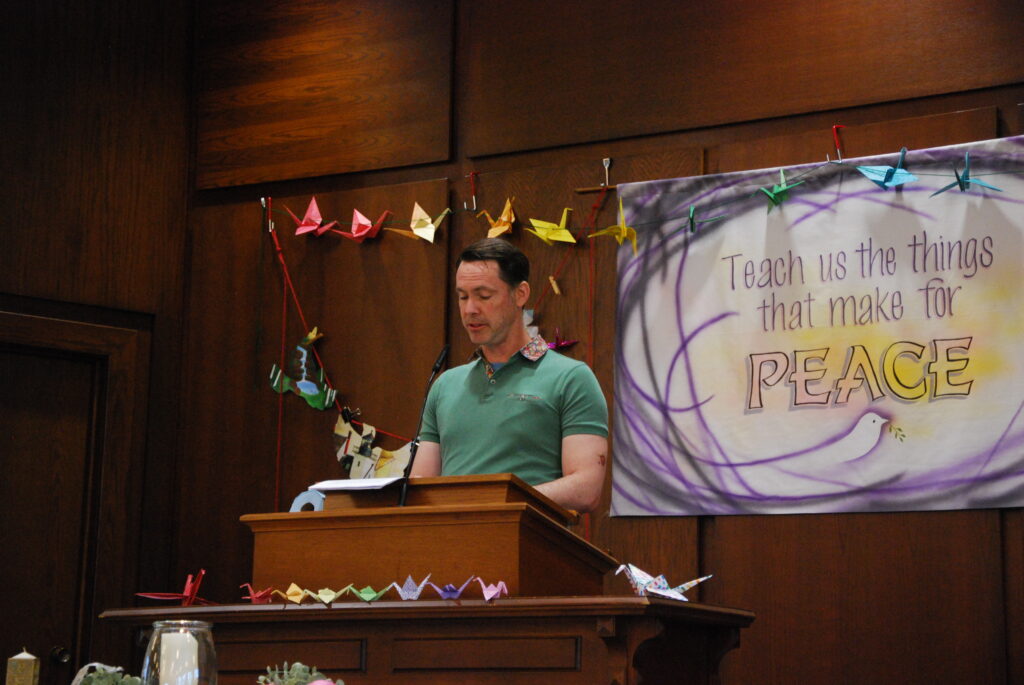
Scott Morton Ninomiya
Once in a blue moon I preach here at SJMC and today that is literally the case in the astronomical sense (it just happened at 4:45 am). I’m so happy to be here, a prodigal son returned to preach at his own church for once.
Today I’ve been invited to add my own contribution to the series on peace. And I’ll start off with a shout out to the artist who gave me an inspirational starting place – thanks Gareth! This beautiful art reflects the reality that I experience in my work. In real life, peace is not something neat and finished. Instead, peace is a puzzle. A puzzle with missing pieces, hard edges, surprising turns, and—by God’s grace—new pieces still being added.
My offering to this beautiful peace puzzle will endeavour to fit together
my own story here at SJMC
the story of the spirit at work in truth and reconciliation
and the gospel story of foot washing
So you can understand how everything fits together, I’ll begin with my story. I guess you could call it a Mennonite love story – like those surprisingly popular books in the library. I bumped into Mennonites first at Grebel – that grand old Mennonite bridal college. Sure enough I found a Mennonite there and married her – right here in this church in 1998. That’s as racy as this love story is gonna get, and I’m sure my daughter is relieved about that. Next I was baptized into this faith community – again right here – in 2000. There I was – a re-baptized Irish Catholic who married into a long Mennonite lineage. I can really play the game now, at least by marriage! Over the years, through worship, service, and community, I’ve come to say that although I have zero percent Mennonite genes, I have a 100% Mennonite heart.
And that heart has been shaped here at SJMC—by potlucks and prayers, by hymns and humility, and by practices like foot washing. One of my first Sundays here was a foot washing service. It was new and strange, but it spoke to my heart to see a community so tangibly integrate one of Jesus’ most powerful embodied teachings into our spiritual life together here and now. I’ll pick up this foot washing piece later.
Also in those early days, one of the first people to warmly welcomed me here, in her irrepressible way – was Doris Kramer. Doris had strong elder vibes, even 30 years ago, and she had the ability to see an odd piece and intentionally integrate it into the Mennonite puzzle. Even a scrawny twenty something trying to find out where he fit in a new faith family. God bless that dearly departed master peace puzzler and all her 102 years. (recovery moment)
Over decades since, my Mennonite heart and feet have taken me on many adventures of learning and service under the name of my faith family. My current work is a prominent part of that journey – I’m the Indigenous Neighbours Program Coordinator with Mennonite Central Committee Ontario. The team I lead works alongside visionary Indigenous leaders pursuing powerful visions for peace, healing and justice every day – you’ll hear about some of them later. We also learn alongside non-Indigenous folks seeking to listen; learn and work together for change. We get to build the puzzle of peace every day together with many people from many places. It’s the most exciting work I’ve ever done.
Now that you know a bit about how I fit into the puzzle of the people of God’s peace, I’ll pick up that second bit of the puzzle – the spirit of peace at work in truth and reconciliation.
1. Peace Is Not a Picture on the Box
One thing I’ve learned in my exciting work with MCC – real life peace doesn’t come in a box with a picture to follow on it.
The kind of peace Jesus calls us to is not pre-packaged. It’s not static. It doesn’t arrive complete. Instead, it’s something we build together, piece by piece—often without knowing exactly what the final picture will look like.
And sometimes, if we are honest, we discover that pieces we thought belonged… actually don’t fit anymore.
For us as Mennonites, this is especially true when we face parts of our history that are painful and complicated.
2. When Pieces Don’t Fit: Facing the Past
In recent years, many of us have learned more about the residential schools that were run by Mennonites in northwestern Ontario from the 1960s to the 1990s.
For many, this came as a shock. Honestly – it hurt my Mennonite heart to learn this. We are used to thinking of ourselves as the “quiet in the land,” as people committed to peace and simplicity.
But the truth is this: the residential school system represents a profound breach of the very peace we profess. It was part of a broader system of colonialism that caused deep harm—spiritual, emotional, cultural, and physical.
Mennonites can’t cover our tracks on that wrong path or hope that time covers them for us. Nor can we count on our humble reputation as ‘the quiet in the land’ to attract less attention than the Anglicans or Catholics. The legacy of Mennonite residential schools and the work to repair harm is a crucial impetus for the work we do on the Indigenous Neighbours team at MCC Ontario. While you may not find MCC listed in residential school records, and other organizations founded the schools, I firmly believe that this legacy must be owned broadly by our big, beloved Anabaptist family.
And so we face a choice.
Do we let time cover our tracks—minimizing, distancing, telling ourselves that “it wasn’t really us”?
Or do we step up—owning our place in the story, not as a burden of crushing guilt, but as a call to faithful responsibility?
Because repentance, in its truest sense, is not about feeling bad. It is about turning—walking in a new direction.
It is about picking up new puzzle pieces, even when they are hard to hold.
3. Invited Into the Work
In 2023, I received an auspicious invitation into some intense work of peace, truth and reconciliation by Indigenous leaders—survivors of those Mennonite-run residential schools.
In response to the invitation, I attended a gathering of survivors in Thunder Bay. Walking into the room where over 40 survivors were gathered was one of the most uncomfortable moments of my life. As a tall, white Mennonite man in that space I felt implicated, exposed and vulnerable.
Honestly, I wanted to disappear.
But peace building doesn’t happen when we disappear. It happens when we show up—but in the moment I didn’t know how. I felt like a piece unbearably out of place.
In my flailing efforts to fit in, I reached out to one of the leaders of the gathering, Jonathan Kakegamic, who is a Mennonite residential school Survivor himself. I asked him if an image on my t-shirt might be triggering to the Survivors. With his dry wit, Jonathan popped THIS white-man-shaped puzzle piece decisively into place. He said: “Don’t worry about your shirt, Scott – you’ll trigger them all by yourself”.
It was both humbling and freeing.
I realized I could not control everything. I could not erase history. But I could choose to stay present. To listen. To walk forward anyway.
That’s one of my most powerful lessons to date about building the peace puzzle:
some pieces are profoundly uncomfortable—but they are necessary.
4. The Table Where Peace Begins
A couple of years later in 2025, I found myself at a kitchen table in Kansas with survivors – Jonathan Kakegamic who burst my tshirt bubble and Emily King. We were there in the home of an elderly former principal from one of the Mennonite residential schools, along with his family. We were there to invite him – face to face – to take part in a second gathering of Survivors, this time in Dryden Ontario.
It was a fragile moment.
Pain was present. Defensiveness hovered in the air. Generations of hurt sat quietly between us.
And yet something remarkable happened.
Through honest conversation—truth spoken with courage and respect—hearts began to soften. Postures changed. Eyes opened. By the end, there were handshakes and even hugs.
The family accepted the invitation to attend and facilitate the process of their elderly father joining the gathering of Survivors by video conference. One of the sons agreed to attend in person.
I have been helping to build the puzzle of peace for over three decades now and the meeting at that Kansas kitchen stands out as one of the most exquisite pieces I’ve ever seen click satisfyingly into place. But it didn’t happen by accident. The Survivor leaders Jonathan and Emily did so much work on so many levels to prepare for that meeting – we witnessed that piece pop into place thanks to their skill, courage, commitment and vision.
To put that Kansas puzzle piece moment in a broader global context, a few hundred miles away in the same state at the same moment, US bombers took off to bomb Iran, remote-controlled from an oval office desk. This jarring juxtaposition makes that Kansas kitchen table ‘click’ reverberate even more strongly in my memory. There were no reporters, no posturing, nothing fancy or loud at that kitchen table. It was just a conversation and the spirit of peace at work in human hearts. This is how the puzzle of peace comes together!
The next step was to prepare our hearts for a second Survivor gathering – this time in Dryden in northwestern Ontario in March 2026.
A Simple Act: Shining Shoes
I can’t tell you everything that happened on that weekend in Dryden, but I will focus on a few prominent pieces that had a lasting learning impact on me as a participant in that process.
During that gathering, one survivor shared a story with all of us that stayed with me. I’ll call him Mr. Rose.
As a child, he had been made to shine the shoes of Mennonites. He spoke about how that experience made him feel—demeaned, dehumanized. Then he said, almost offhandedly, that maybe one day he would have a Mennonite shine his shoes.
That moment lodged deep in my heart.
I wondered if I might be called to respond in a personal way. I went to speak with the traditional healer on duty at the gathering to request spiritual guidance. I asked him to smudge me, a ritual cleansing with sage smoke common in many Indigenous traditions. Silently, I hoped this would clear any misguided intentions so I could listen to my deepest heart. In my work, I’ve learned how painfully true the saying “the road to hell is paved with good intentions” can be, and I didn’t want that to apply to me. After smudging me gently and thoroughly, I shared my idea. He considered it and advised that I could ask and see how he responded.
With renewed confidence, I went next door to a gas station to find something to shine the Survivor’s shoes. I spotted heavy-duty paper towels labeled “SCOTT.” I don’t believe everything is a sign, but seeing my name struck me, so I bought them. Here’s the roll!
Back in the conference room, I found Mr. Rose, thanked him for his stories, and introduced myself. Showing him the paper towels, I said, “Mr. Rose, I’m a Mennonite, and if you’re open to it, I’d be honoured to shine your shoes.” He smiled, laughed softly, and said yes. I knelt and began buffing the road salt from his boots as he quietly prayed, “thank you Lord… thank you Lord.” I finished, shook his hand again, and thanked him for the honour.
Later that day I realized that around the same time, my home church here in St. Jacobs was holding its annual foot-washing service. I remembered first attending that service in 1999, feeling the power of shared humility and a sense of spiritual home. In hindsight, I carried those lessons into this act of repentance that Sunday in Dryden. It was literally amazing grace that clicked together so many puzzle pieces that day – the story of our faith communty – click, the story of peace at work in truth and reconciliation – click; the gospel story of Jesus washing feet to show us how we assemble peace in this world –Click. A rare and profound moment. It was thanks to all of you and everything you’ve taught me by word and example over the decades that I was able to put the gospel story into action.
For those of you joining this beautiful church family today – you bright shiny new puzzle pieces of the SJMC puzzle, I want to welcome you into this congregation that has taught me so much about how to assemble peace together. I’m sure Doris Kramer’s spirit is here in all our hearts as we welcome you new pieces the way she would have.
I want to say from the heart: Welcome to the faith family. Welcome to the work of peace. Welcome to a wonderful feeling of clicking together and fitting in. As we continue to follow Jesus example and pursue peace, repair, and repentance together, we must also talk about who we are becoming. Remember there’s no picture on a box to follow.
Because every time a new person walks through our doors, like today, the puzzle changes.
New people bring new stories. New perspectives. New questions. Sometimes new discomforts.
And that can be unsettling.
But it is also a gift.
Because peace is not only about repairing what was broken in the past.
It is also about building a future that reflects the wideness of God’s love.
You are essential pieces.
Because if peace is like a puzzle, then God is still adding pieces.
8. The Courage to Keep Building
With no box to follow, and a world where peace sometimes feels impossible, where does that leave us, together here at SJMC?
It leaves us here:
- With a past we cannot ignore
- With a present that is often messy
- With a future still being formed
And with a call to keep building.
Piece by piece.
Step by step.
Not perfectly—but faithfully.
We are not called to complete the puzzle alone.
We are not even called to finish it.
We are called to participate. In truth and reconciliation, in supporting justice around the world, in acts of service and justice here in the community.
To pick up the piece in front of us—whether that looks like listening, welcoming, serving, or simply staying present when it would be easier to walk away.
9. Invitation
So today, I extend an invitation to all of us.
Come into the puzzle.
Because the peace of Christ is something we must assemble together.
Whether you’re a young puzzle artist, a 50 something peace worker finding his place in truth and reconciliation work, or an esteemed elder who helps new pieces feel like they fit in, we’re all called to help assemble the great puzzle as people of God’s peace.
Amen.