
I love a Scripture passage and a sermon where you have a very clear and straightforward image from Scripture to start with and you can build the whole sermon on it. It makes it easy and poetic, with everything tied up neatly in a bow. I just knew we had that kind of image for this Sunday: The Cornerstone! How easy and straightforward that would be. ‘Jesus himself as the cornerstone.’ Just follow along… but it’s never as easy as you think.
First, what is a cornerstone? When builders create a house, a building, a stone structure you usually have a cornerstone, especially for a masonry foundation. This is the foundation stone placed on the very corner of what is about to be built, at the corner where two walls will meet. It is usually a big stone, solid, squared, immovable. Sometimes it is a special material. It provides the foundational stability to the rest of the building. It also provides the alignment. All the other stones, walls, structures, are measured in line with this cornerstone – to keep everything straight and even, aligned. Sometimes the cornerstone will have important historical information imprinted on it – for sure the date of initial construction, but it cold also be the names of the architect or builders, or a phrase or insignia. Sometimes there were even treasures hidden within the cornerstone, memorabilia or a time capsule. There were often public celebrations when this cornerstone was put into place. The problem is, sometimes this cornerstone became more ceremonial than actually the key foundation piece that held the structure together. This special stone was simply somewhere else in the wall, not holding everything up. Or it became more of a head cornerstone, that is placed above the two walls to keep them together and prevent them from falling. In a masonry arch it is called a capstone, where it is the last stone, the final piece, placed at an angle at the very apex of the arch, and it bears the weight of the structure as everything else leans in to the centre. We saw this in Chuck’s demonstration. So it is the last, and not the first stone. All of these are cornerstones, and already it was feeling more complicated.
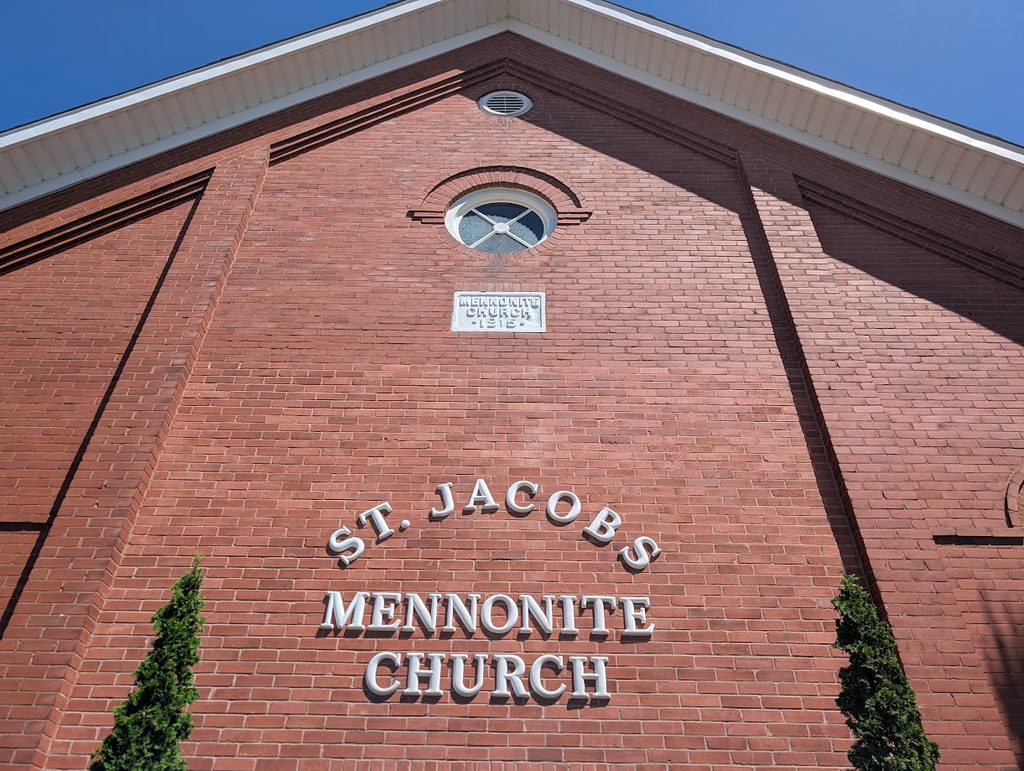
I was curious, and decided to look around our own church building here at SJMC to see what I could find. Maybe there is one, but I couldn’t find an identifiable ground level cornerstone of the original 1915 church building, that holds up this whole building. I did find a stone near the front North West corner that marked the 1936 addition, at least near the ground. Then I found the ceremonial cornerstone for the 1990 addition in the South East corner, raised several bricks above the ground. I finally found the original cornerstone of the church ….I had to look up. It is way up high on the wall at the front of the church, above the name of the church and below a fancy little circular window: ‘Mennonite Church 1915’. It clearly was put there to mark the year and occasion, but has nothing to do with the structural integrity of the building. Hmm…
So I started to explore this cornerstone image in the Bible. There is a passage in Isaiah 28, in the context of the people breaking covenant, where God says he will lay in Zion, a foundation stone, a tested stone, a precious cornerstone, a sure foundation – and justice and righteousness will return. That makes sense. Then in Psalm 118, it says that the stone that the builders has rejected has become the chief cornerstone, and that this is the Lord’s doing. Hmm… Why would you use the stone that has been rejected? Wouldn’t that be the one that was mis-sized, crooked, uneven, of poorer material? Why use that rejected stone to build everything else up on, as the cornerstone? But the rejected stone seems to be the alternative that provides new hope and promise and life – more of a living stone. It is this Psalm 118 line that keeps getting quoted in the New Testament – in the gospels and in the book of Acts – Jesus is the stone that the builders rejected, or in Acts, that you, the builders, rejected, that has become the cornerstone. The rejected now the new living foundation.
All this brings us to the letter to the Ephesians, a famous passage in chapter 2, where Paul also names ‘Christ Jesus himself as the cornerstone, in him the whole structure is joined together and grows into a holy temple in the Lord in whom you also are built together spiritualty into a dwelling place for God.’ (2:20-21). This is the last sentence of a larger paragraph. To understand what is going on here, and what Paul means, we need to look closer at the whole passage.
Some context here. Paul is writing to a church in Ephesus, that is struggling to figure out how followers of Christ from both Jewish and Gentile background, can now be a part of the same fellowship, the same church body. Those of Jewish background have this long history of faith, and practice and experience. Jesus is now a part of this. With those of this Jewish background there is confidence in how faith works, and an assumption of being a part of a long history of promise and covenant. Those of Gentile background are the newcomers, the strangers, the inexperienced ones in faith. They too have met up with Jesus and the gospel, and have claimed faith, but it is still so new. They don’t know the practices, and assumptions, and ways of doing things. It makes things awkward. Conflicts arise. Sides are taken. Power plays happen. This is a situation of insiders and outsiders. The divisions are clear, and Paul knows this, but also knows that Jesus changes everything. ‘But now in Christ Jesus you who were once far off, the Gentiles, the newcomers, have been brought near by the blood of Christ. For he is our peace… he has made both groups into one and has broken down the dividing wall, that is, the hostility between us.’ Paul is quoting Isaiah 57, Jewish Scripture – ‘Peace, peace, to the far and the near,’ a reference to those in Exile. As Tom Yoder Neufeld says in his wonderful Ephesians Commentary, ‘by recasting the estrangement of Gentiles as exile from home, this text is surely a profound act of peacemaking. Gentiles are invited to make the family history of their enemies their own, in effect, to come home.’ (Believer’s Church Commentary, Herald Press, 2002, p.111). Jesus makes both people feel at home. eawr
This is the ultimate peace passage. Paul talks about abolishing the law and commandments and ordinances that stand in the way, and creating one new humanity in place of the two, thus making peace, reconciling both groups to God in ONE body – putting to death hostility itself, proclaiming peace to those who were far off, and those who were near – everyone is a part of, a full member of, citizens of, the household of God.
The image Paul uses is that of the dividing wall, and that Jesus breaks down the dividing wall. It might be a reference to the literal dividing wall in the Temple that separated the Gentiles from the inner holier parts of the Temple that only Jews could enter. But it is also the walls that so easily exist between peoples. We know about literal walls that divide – The Berlin Wall, the wall between Israel and the West Bank, the US- Mexico Border Wall and so on. They are physical, but also soon become psychological, a naming of who is in and out, acceptable and unacceptable – who is to be feared as the outside, the stranger, the foreigner, the immigrant to be deported, on the other side of the wall. We also know more personally that we create psychological and emotional and spiritual walls and barriers between other people and ourselves. We treat people as other. Jesus breaks down all these walls, breaks down the dividing wall, and makes both groups into one.
And here is where Paul gets to the cornerstone. You are no longer strangers and aliens, but citizens and members of the household of God… built upon the foundation of the apostles and prophets, with Christ Jesus himself as the cornerstone. In him the whole structure if joined together – and then it becomes more organic, living – and grows into a holy temple in the Lord; in whom you also are built together spiritually into a dwelling place for God. Janet spoke last Sunday about the image of the Temple and Jesus as the true temple that can satisfy the deepest longings of our hearts. So instead of a wall, you have something being built spiritually, growing, with Jesus, remember, the one who was rejected, with Jesus as the cornerstone joining everything together. Tom Yoder Neufeld writes that this Greek word ‘cornerstone’ could also be ‘headstone’ or ‘keystone.’ It might be this foundation that provides orientation, but, he writes, ‘perhaps the author is thinking of the stone set at the very pinnacle of the temple… or it might refer to the stone at the apex of an arch against which the other stones lean and by which they are given their structural integrity… the ‘angle stone.’ (Ibid. p.126-7) So for me, the image this pointed to in my mind was a bridge, a bridge, an arch, that connects and brings together – a bridge instead of a wall. From diving wall to unifying bridge.
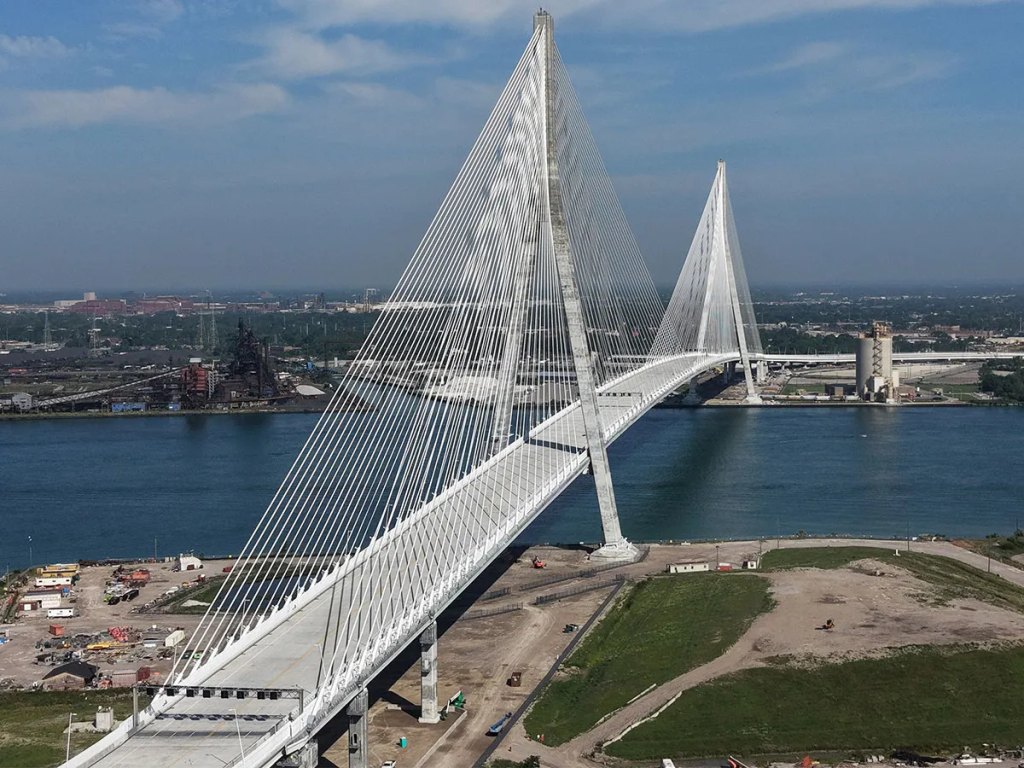
At the end of July, Rachel, Nathan and I drove down to visit her family in Bluffton, Ohio for a 92 birthday and a 67th wedding anniversary. We have made that trip to the US many times, but this time we noticed a new change about to happen. We were crossing the border the weekend just before the new Gordie Howe Bridge was about to open that Monday. We saw the new signs about to direct vehicles straight from the 401 to the bridge, avoiding 7-10 stoplights through Windsor, and making a much easier and cheaper and multi-laned and quicker entrance into the States. We just missed driving on the new bridge. Next time!
The Gordie Howe Bridge has been much in the news lately, with its opening delayed for several months while a certain President demanded a whole new arrangement, spurred on by the billionaire owner of the now rival almost 100-year-old Ambassador Bridge. There is a larger challenging context right now of strained cross border relationships, highlighted by all the renewed tariffs talks and threats we’ve seen even this week. But that is not where the vision of this bridge began when it started being built in 2018, to much hoopla and joint celebrations, and after years of background work and permits, procurements, and mutual cooperation and understandings. The project involved over 3900 workers from both countries, 145 local businesses, 6.4 billion dollars, and over 20 million working hours!
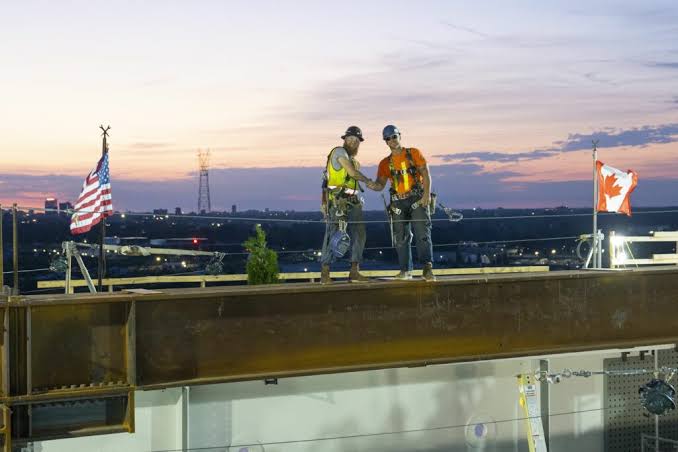
So how does such a massive bridge stand up and support itself? There is not some singular cornerstone. I am not sure I totally understand it, but this is what I gathered: The most interesting thing about the construction of the Gordie Howe bridge, is that the work started independently on both sides of the border, and was slowly built towards each other, seeing if both sides would meet. They began by drilling down, by creating the foundations, with massive underground supports 36 meters, 10 stories deep, 262,000 pounds of concrete. Then they built up, the legs or towers on each side – 40 meters or 11 stories high. The trick then was how to span the 2,800 feet, 852 metres, between these pillars, between the two countries, with the total length of the bridge, including approach structures, being 2.5 kilometres. It mostly involved massive thick cables, 1600 meters of tensioning cables. It is the longest cable stayed bridge in North America. As one article said ‘there was no cornerstone, but rather construction relied on massive drilled shafts, massive concrete towers and structural segments.’ But would they line up? On June 14, 2024, the Canada side and the US side finally approached each other, and sure enough, lined up perfectly and were joined together. It was like Chuck’s arch finally coming together in the middle. . There was a famous symbolic handshake between two iron workers – Casey Whitson from Michigan and Jason Huggett from Ontario, and the photo was broadcast around the world. They had never met, despite each working on the same bridge, just from different, unconnected sides. But they were so exited to see the two sides of the bridge join together. They called it the ‘best moment in their careers… an incredible moment, a cool moment. Everything felt right up there.’ There was this coming together, not just of the bridge, but of relationships, of people. The bridge had become a symbol of togetherness, or walls being broken down and turned into a bridge. These two ironworkers were interviewed now, just before the opening of the bridge. (https://www.cbc.ca/player/play/video/9.7286407) . They lamented the current nasty political context. Casey Whitson quipped ‘this a monument for both countries and both cities. Just with what’s going on politically, it just ain’t right.’ Jason Huggett continued ‘It should be the two countries coming back together. This is what the bridge is all about.’ (Photo 6 – Gordie Howe Bridge 2). So yes, the Gordie Howe Bridge has opened and has lots of traffic already. But the relationship between our two countries is bumpy. Over time, can the symbol of this bridge begin to unit us rather than divide?
Building a bridge instead of a wall is not easy. It gets complicated – in the building process itself, but also in its symbolism, what the bridge represents, how it is used. It is so easy for more walls to be built up, more barriers, more distrust and division, more rejection. But can we imagine trying to build bridges with others, with those who are far and near, with those we disagree with, with those who are different, with those from whom we have been most divided? Paul reminds us that Jesus is named as the cornerstone, as the one in whom the whole structure is joined together and grows into a holy temple in the Lord, in whom we are built spiritually – into a dwelling place for God. That is when everyone can truly feel at home. That is when walls become bridges, and hostility is transformed into peace. That is our complicated, but totally satisfying promise. May it be so. Amen.