
The weather is slowly heading towards winter, and on a few mornings now already, the front and side windows of my vehicle are all foggy when I head to work. I have not had to scrape yet, but that day is coming soon. It is irritating. You turn on the front defrost full blast, but know nothing will change for awhile until the vehicle warms up. You turn on the windshield wipers, and they sometimes clear the windshield for a second, before instantly fogging back up. It is an inside thing more than outside. Your vision forward is compromised. You can see things, but they are blurry, not totally in focus. You only get glimpses. You sometimes end up ducking down to see out of that little hole of clarity at the bottom. When you get to a stop sign, you roll down both windows so you can see either way before going. You see through a glass dimly. A wiser, more patient driver would wait in the driveway until all is clear, but that kind of patience is not my gift. Can anyone else identify with this windshield experience?
It is this image of a fogged-up window, of seeing through a glass darkly, that guides our Eternity Sunday service this morning as we reflect on the mystery of death itself. The image comes from Paul in 1st Corinthians – ‘Now we see through a glass darkly, or see a reflection in a foggy mirror; then we will see face to face. Now I know partially, but then I will know completely in the same way that I have been completely known.’ The famous 1st Corinthians passage about love that we heard this morning is most often associated with weddings, especially the first part. It is probably the most common wedding passage read, and it makes sense. It is all about the nature of love, and the poetry is wonderful. I have often shared a meditation from this love passage at weddings. I will talk about the joys and beauty of love, the qualities of love, and how it is love that endures in a relationship, that puts up with all things, trusts in all things, hopes in all things and endures all things. When James and I met to plan for today, we noted that Paul uses the Greek word Agape for Love. Agape Love is that unconditional, selfless, sacrificial love, the kind of love God has for us. Paul didn’t use Eros Love, the love of romance, passion and desire, or Phileo Love, the love in friendship of trust and camaraderie and shared experiences and values. Agape love is a deep abiding love, one nurtured over time, steadfast, unconditional, lasting. So lots about love in this passage.
But at a wedding, I will also tend to pick up some of these phrases and themes from the end of the passage. There is a mystery in marriage, and when a couple gets married, they know only in part. There will be challenges and hard things to come that will need all the love and trust and faith that has been pledged at the wedding for them to endure. We see our partners through a cloudy glass, and only in that vulnerable journey of life do we become more and more known to each other. The couple will need to be real with each other, to see more clearly, to love more deeply. I have even pulled out a pair of sunglasses in a wedding meditation as a visual reminder.
So while we associated this passage with wedding, this passage may have just as much to teach us when we reflect on our journeys of life and death. What is it that endures to the end, that remains to the end, but love? I was struck how often Paul uses the word ‘end’ in this passage – 4 times. Prophesies will come to an end. As for tongues they will cease. Knowledge will come to an end. Prophesy, what we know only in part – the partial will come to an end. There is an honesty here about the limits of our humanity, of what we can know and understand, about things ending, maybe particularly about death. This is where Paul uses this image of a cloudy mirror, or seeing through a glass darkly. It will be foggy. We won’t understand. Death will continue to be a mystery, even as we trust the promises of God and God’s Eternal Care. But we do get glimpses – of God’s love bursting into our lives, even as we face death.
One of the very hard deaths this past year was that of Bryan Schroader Kipfer, and it is good to have Anita and (several of) your children here in worship with us this morning. With the connection of their/your family over the years to SJMC, I was invited to walk with Byran, Anita and their four children on that journey with cancer, and to preach at his funeral in July at Floradale Mennonite, where Anita is pastor. There were no easy words or simple answers. We held much mystery and unknowing, and we desperately held on to Love. In addition to Psalm 5 for the service, Anita choose to recite a poem by Lord Alfred Tennyson – ‘Crossing the Bar’, which a quartet also sang. You can read the full poem in your bulletin, and we will sing that song after the sermon. Tennyson wrote this poem in 1889, 3 years before he died. He told his son Hallam to put ‘Crossing the Bar’ at the very end of all editions of his poems. It was a kind of final word, a final gift as he reflected on his own death. Many years earlier, after the shattering death in 1833 of his close friend Arthur Hallam at 22, namesake for his own son, Tennyson wrote the famous lines ‘Tis better to have loved and lost, than never to have loved at all.’ (In Memoriam A.H.H.) There is a struggle in his life to understand death. And yet, a recognition that it is Love that endures – that it is better to have loved and lost, than never to have loved at all.
In Crossing the Bar, Tennyson picks up this image, found so often in literary history, but also in Scripture, of crossing the river, in life and in death. The people of Israel crossed the Jordan into the Promised Land, letting go and leaving behind what had been. Abram crossed the land of Canaan. There is the crossing of the Red Sea. Jesus crossed the religious boundaries of his day, and through his Incarnation, crossed over and joined us in our humanity. (ideas from Rev. Dr. Blythe Denham Kieffer) A crossing is a major transition, a new unknown path. We have many crossing within our own lives – in a sense, little deaths and new life, where we practice death. Crossing the river, crossing the bar, then, also becomes a metaphor for death and dying. ‘May there be no moaning of the bar when I put out to sea,’ when you cross past that sandbar into the boundless depth of the ocean, to a tide so full that it cannot contain sound or foam. His hope is to ‘meet my Pilot face to face’ to meet God, the divine, echoing our 1st Corinthians passage. In another place Tennyson writes’ The Pilot has been on board all the while, but in the dark I have not seen him… (He is) that Divine and Unseen who is always guiding us.’ (https://en.wikipedia.org/wiki/Crossing_the_Bar) It is a recognition that we only see through a glass darkly, but hold on to that promise of one day seeing face to face.
As I prepared for today, I reflected on the lives of those who have died from our congregation in the past year, and over the last many years. I was filled with gratitude for each of these lives. We will mark 7 deaths in a few minutes by lighting candles. I did a little check through my files, and I have had the privilege and honour of being a pastor at about 115 funerals, memorials, celebrations of life or committal services directly connected here to St Jacobs Mennonite, plus some others in the broader community, each of them different, and each honouring the significant and unique life of the person who has died, of putting their story within the larger story of God and God’s love. It was so good to simply read those names to myself and remember. I found myself smiling fondly as I remembered stories and personalities. Each death and each funeral is its own unique journey. I have learned much and still have so much to learn. When my Dad Gary was dying in the Guelph Hospice, I remember talking to one of the staff, who made the comment that pastors sometimes have the hardest time in Hospice as they are dying, because they have been at so many deaths and part of so many funerals that they think they know what death is about, until it is theirs, so real, and they are looking through that glass just as dimly as anyone else. And so I share a few observations humbly and without any pretense of answers or certainty, but simply what I have noticed, over the years, and what I have come to believe.
- And maybe the first observation is how death is shrouded in mystery. In death we come up against the limits of our humanity and our understanding. We are not in control. We draw upon images and imaginations, but none of us know what death will be like. We don’t understand, and that is okay. One of life’s biggest lessons is to accept that we are not ultimately in control.
- I also recognized how different each situation is, and that each person, each family, approaches death, and the time around death in their own unique way. As a pastor, you are invited to step into each family system, and to walk with the questions, experiences, joys and struggles they might hold. It is a true honour. There is a whole range of emotions and ways of dealing with grief and loss. There is no right way to die, or right way to remember, to hold that funeral or celebration of life, or burial or nothing at all.
- What death does do, is make things real. It brings out true honesty and real-ness. Our emotions are raw. We can’t hide behind niceties and trite words. It can be easy, especially in a visitation line, to not know what to say, and to say it was meant to be, or it was their time, or God needed another angel. It reflects our own fear and unknowing, and that is okay too. Sometimes silence or a few simple words or a hug is all that is needed. Death can let us remove the superficial and get to what is real. Faults and giftedness are all out there in the open, and there is something refreshing about that. This sometimes means that the tough family dynamics are out there, just as the gifts and resilience of family are on display. I am amazed at how families hold all of this, and how healing and hope and trust and gentleness and love emerge, even reconciliation. There is a beauty in a funeral when we are able to actually recognize the real person, both the faults and gifts of the deceased, and bring that person before God.
- It is often exactly when we are the most real, most vulnerable, that God shows up, that we get those glimpses of the divine poking through the clouded windshield.
- I think about the depth of compassion, caring, and kindness shown, and the recognition that God walks beside us right in that moment of death or in watching the death of a loved one. There is a sacredness in death, and even through all the hurt and agony, it is a holy time too.
- I think about a person able to look back and give gratitude for their life, even when there have been hard times, gratitude takes over.
- I think about both the tears, and sometimes the laughter, that is able to be unleashed, to be released. There are so many emotions. A few weeks ago, I went to the special exhibit at the Ken Seiling Waterloo Region Museum on Homer Watson called ‘Dying Matters.’ It examines the customs and practices around death from various time periods and background and faiths, including several videos featuring among others, familiar staff from Dreisinger Funeral Home – Grace and Tamara. (Photo 1 – Stages of Grief) In one room, they did a new take on the Elizabeth Kubler Ross Stages of Grief, pointing out how we actually move back and forth among all sorts of different emotions as we grieve, as depicted by the yarn that you could wind around yourself as fit your own journeys. (Take Photo Down)
- I think about the honest authentic heartfelt prayers lifted up, and sometimes sighs too deep for words, and a closeness to God.
- I think about stories told and experiences recounted – from the wild to the sublime… and noticing that God was there in the stories.
- I think about the important naming that often happen – naming fears, naming joys and disappointments, naming pain – physical, emotional and spiritual, naming questions, naming limitations, naming strengths, naming what is really going on within one’s family, naming what is unfinished, naming trust in what will come. These are gifts from God.
- I think about moments of reconciliation, forgiveness, and a letting go that really only comes as gift from God. Death is the ultimate letting go. So much of the journey toward death is learning how to let go – letting go of abilities and health, of possessions, of memories, relationships, of hopes and dreams. I wonder if learning to let go well is something all of us should practice at whatever stage of life we might be in. This is a spiritual journey we are called to.
- I think about the concrete expressions of support given by friends and church and community that help sustain and lift people through. So often I have heard someone say that couldn’t imagine doing this without the support of the church, of family, of their faith.
- I think about the meaning making that happens, that deeper understanding that our lives are a part of God, and our story is found within the story and reality of God.
- All these glimpses of God are sometimes overwhelming, even as they are awe-inspiring and holy. We get to see with some clarity out of that small hole in the bottom of the windshield. We recognize that with God we are fully known.
- And more and more, what I see and observe and experience around death, is that gift of Love. When it comes down to it, it is Love that is left at the end. Love of a spouse, Love of family, the Love of God. That’s what endures. And now, faith, hope and love remain, these three, and the greatest of these is love. This is that Agape Love – that unconditional, sacrificial, steadfast, deep abiding Love. When all else fades away, so much letting go, it is Love that is held and love that endures. That is what we see clearly.
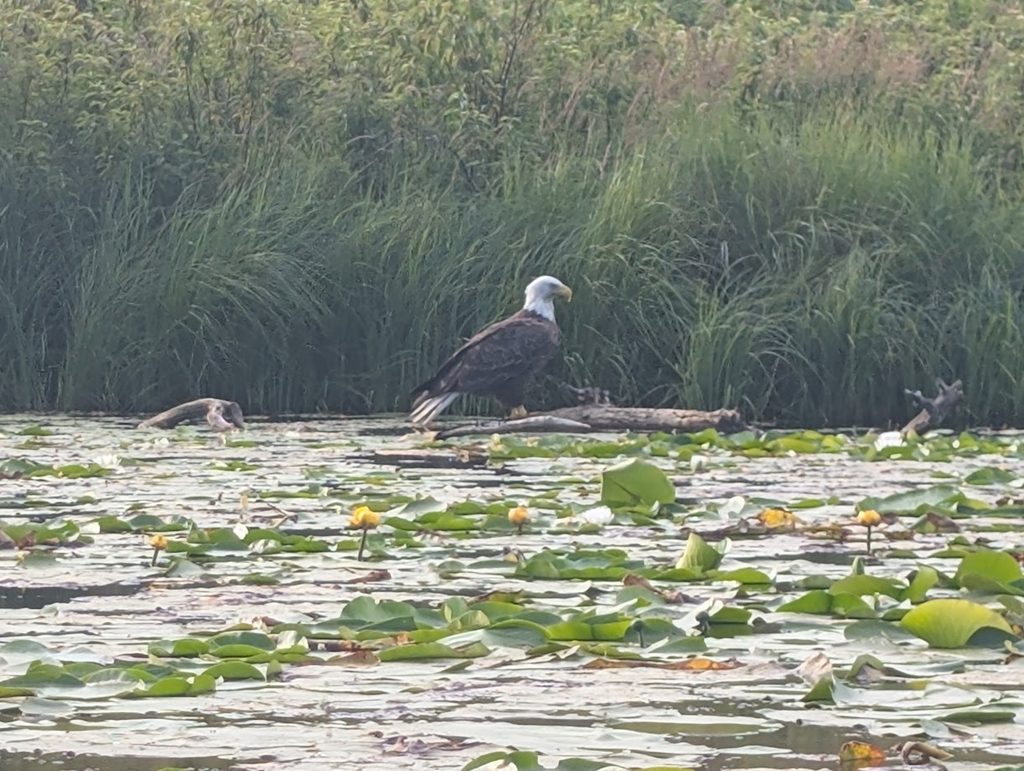
Rachel and I were camping at the Pinery when I received the call that Bryan had died, and I headed to Listowel Hospital. I shared the following story at the funeral. As we were getting ready two days later to leave the Pinery, I took one last kayak on the river, the Old Ausable Channel, behind our campsite. You cannot be in a more peaceful place. It was the peace I needed as I continued to process and hold Bryan’s death myself. As I paddled and turned the last corner back to our campsite, there on the edge of the reeds and high grasses, stood a huge mature bald eagle on an old log. (Photo of Bald Eagle) I have occasionally seen bald eagles before, usually a quick glimpse in flight before disappearing. But this one just stood there, staring at me, for maybe 10 minutes as I floated in the water nearby. I couldn’t help but think about Bryan, it was a Bald Eagle afterall, but also his stillness and steadiness and the calm gift of acceptance and trust he had about his death. It was all there in that eagle, and I think now of all the people we are remembering today. This grand bald eagle finally moved and flew over me, but just to a large oak tree on the other side of the river, where he sat perked up high, viewing everything around from that larger perspective – the bird’s eye view. It was me who finally paddled away, holding that precious time in my heart. (Take down Photo) That eagle was a gift to me that morning. It gave me a broader perspective. So often we see through a glass darkly. But that morning the fog had lifted. There was that crossing the river, crossing the bar. And in that crossing, we see face to face. There is a clarity, and clearness, a recognition that in the end, it is Love that endures, and God who is present with us. We glimpse God through the clouded windshield, even in the mystery of death itself. That is the hope we carry on Eternity Sunday.
Sunset and evening star,
And one clear call for me!
And may there be no moaning of the bar,
When I put out to sea,
But such a tide as moving seems asleep,
Too full for sound and foam,
When that which drew from out the boundless deep
Turns again home.
Twilight and evening bell,
And after that the dark!
And may there be no sadness of farewell,
When I embark;
For tho’ from out our bourne of Time and Place
The flood may bear me far,
I hope to see my Pilot face to face
When I have cross’d the bar.