

God of Justice
Hey God, are you there? That was my first reaction upon reading Psalm 146, and when Brent and I met. Are you really a God who executives justice for the oppressed and lifts up those who are bowed down, loves the righteous and watches over the strangers, bringing the wicked to ruin? Just look at our world right now! It feels like injustice is thriving and growing by leaps and bounds, and that everywhere you turn, the powerful are defining the narrative, there is a growing bias and violence against the most vulnerable – the immigrant, the homeless, the foreigner, those who are different, those who can be labelled as ‘woke’, the rich are growing richer at the expense of the poor, and some of the very foundations of order and decorum and fair process are crumbling around us. There is a kind of backlash to what felt like the gains made in equality and justice for all. We see all the global violence and injustice in our world – Gaza, Ukraine, Sudan, Myanmar, the United States, and yes within pockets of our own Canadian context. There is an overall sense of unease and distrust. Justice is losing right now, isn’t it? I have often taken solace in the words of Martin Luther King Junior – ‘the arc of the moral universe is long, but it bends toward justice.’ For much of my life, it has felt that slowly that bending has been happening, in so many little and big ways, but more lately, it feels more like a pendulum than an arc, and that the pendulum has been swinging back rapidly, undermining so much. So I was feeling a kind of disconnect to the surface words of Psalm 146. I needed to spend more time with the text, with prayer, with learning, with listening, with asking questions. How can a text like Psalm 146 speak to us today, in our particular context? What are the threads that connect this passage? I needed to dig deeper. Hey God, are you there?
So I started where I often do – turning to recently deceased Old Testament scholar Walter Brueggeman, and his Psalm Commentary (Walter Brueggemann – The Message of the Psalms, Augsburg, 1984, p.158-159), to see how he places and approaches this particular Psalm. Janet already introduced Brueggemann’s overall shape in the Psalms of Orientation, Dis-Orientation and Re-Orientation. Psalm 146 is one of the Re-Orientation Psalms – the surprising return to and re-affirmation of God after a long period of Dis-orientation, of the world not feeling right. This comes as an unexpected gift from God. It is one of the last 5 Psalms in the whole collection, all Psalms of Praise, which is how this one starts and ends – Praise the Lord, O My Soul. These Psalms shy away from the particulars we have seen more in the earlier psalms. While it doesn’t name the specifics, the people have been through tough times and come out on the other end. So these Psalms contain a more generalized confidence that God, Yahweh, is ‘utterly trustworthy in the face of every threat.’ (Ibid, p.152) This is big picture stuff, the larger view of how God works in the world. They are also more about who God is than who humans are. Psalm 146 even sets this up as a contrast. Where do you put your trust? Do not put your trust in princes and leaders… They cannot save you. Their plans die with them. Hmm… we need to hear that in our day. Human decisions and power and actions are temporary, finite, will come to their end. Put your trust in God, happy are they, whose hope is in the Lord, the great Creator of heaven and earth, for the Lord is always faithful – or in the NRSV – ‘keeps faith forever.’ – the Hebrew word ‘emet’ – used 127 times, for faith, truth, right, a kind of integrity that is personal and rooted in God’s very being. This is not an intellectual concept, but an embodied virtue. This psalm brings us to the core of who God is, and sets that as an example for us to follow and model our lives on. I find this bigger picture helpful.
I then turned to the specific description given in Psalm 146 about the very character of God. And this was all about justice and righteousness – about giving food to the hungry, setting the prisoner free, opening the eyes of the blind, lifted up the lowly and upholding the stranger, orphan and widow. This is such a common theme in the Old Testament, and right away I hear its echoes with Jesus, especially the words he quotes from Iasiah 61 in Luke 4 when he declares his mission in his home town of Nazareth. This is also where I found the Bible Project video we just heard on the meaning of Biblical Justice, and I figured the video says it as good and better than I can in my sermon. The video talked about the Hebrew word Mispat/Justice, which appears 121 times the Old Testament and Sedaqa/Righteousness – 206 times. They are everywhere! These are not Western intellectual concepts like we tend to think of them, but rather embodied virtues, ways of living and being. As the video said, they emerged from the conviction that humans are set apart and created in the very image of God, which also means seeing and treating others, especially the most vulnerable, with dignity and respect as also created in that image of God. This is not retributive justice, punishment, eye for an eye, three strikes and you’re out, but rather restorative justice, right relationships, advocating for the most vulnerable, uplifting others, and changing the very social structures and systems of society so that all can thrive. It is a radical way of life, fueled by the words of Micah to act justly, love mercy and walk humbly with your God. Another scholar, Klaus Koch, (The Prophets – The Assyrian Period, Fortress Press, 1982, p.58-60), talks about justice and righteousness as spheres of power or activity, or moral forces, almost like living beings, that get unleashed in our world and have a positive life of their own towards good. They get embodied by people and communities in how they live faithfully, and they can just as easily get destroyed through misuse and indifference. He says they resemble a fluid, that can pour out healingly like a river over the people, or turn into a bitter liquid when ignored. He quotes Amos 5, the motto of House of Friendship, ‘but let justice roll down like a river and righteousness like an ever-flowing stream.’ This understanding of justice and righteousness also starts to shift from just being about who God is, which is what we hear most explicitly in Psalm 146, to who we ought to be and how we ought to act in our world. That is simply understood by the Psalmist, even if not explicitly said – we are to model our lives after this God of justice. This started to gain traction for me – how we can be and act, even in a world that so often feels unjust.
Finally, this Psalm 146 starts and end with worship and praise, and then intimately connects that worship of God with justice and righteousness. The two are inseparable. You can’t have one without the other. If we worship and praise God, the creator of heaven and earth, then we also must follow the example of God’s faithfulness and justice to the oppressed, and concern for the lowly. Through worship and what worship does with us, we become the hands and feet of God in executing this justice and righteousness. Amos 5 makes that same connection through a warning, to a people who had ignored justice, pushed aside the needy right in the gates of the city, and trampled on the poor. ‘I hate, I despise your festivals and I take no delight in your solemn assemblies (your worship). Even though you offer me your burnt offerings and grain offerings, I will not accept them… Take away from me the noise of your songs; I will not listen to the melody of your harps. (and then the famous verse), BUT, let justice roll down like waters and righteousness like an ever-flowing stream.’ (Amos 5:21-24). It is a harsh warning to the people of God when worship and justice do not go hand in hand. Hearing this Psalm 146 in worship, should prompt us to ask where we can participate in God’s healing and reconciling justice project in our world, what Brueeggemann names as ‘generous advocacy.’ (Ibid, p.163).
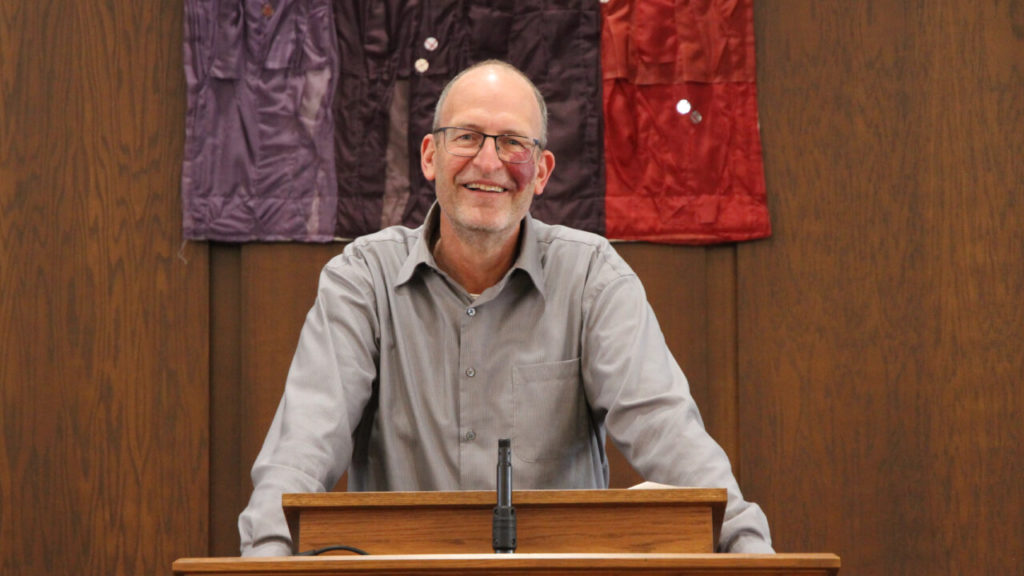
For this whole Fall Worship series, we will have the visuals you see up front here that Kandace created and put together and Janet described so well in a recent sermon and pastoral newsletter. Like many of you, I keep looking at the display, and letting it draw out my feelings and emotions and wonderings. I love how we can all take it in, and interpret what we see, give it meaning. For me today, the three panels, the plain, the burlap and even the coloured panel, are all muted, subdued, plain, basic, and perhaps reflect where our world is at right now. But it is the red thread I keep looking at. Part of me is disturbed by how random and disorganized the red thread appears, winding its way this way and that, with no seeming pattern – it’s kind of like how my grand-daughter Briar’s first colouring attempts look as she begins to pick up and use a marker or crayon. But that also reminds me of the pure joy and life in that new activity – the new eyes to see. I started to see this red thread as that joy and life and presence and justice and righteousness of God, weaving its ways through our lives and our world – not necessarily in straight lines, so often behind the scenes and bright lights, but into the places that need it most – coming as surprise and gift – as new orientation when we most need it – as Janet described – ‘it is God’s steadfast, tenacious, relentless solidarity with us,’ through all the ups and downs of life. I want to hold on to that red thread this week, and Psalm 146 has helped me do so.
I went back to that famous quote by Martin Luther King Junior, which came from a powerful speech he gave on March 25, 1965 on the steps of the Alabama State Capitol after the third march to Montgomery. It is a speech that connected his worship of God as a practicing Christian to the tough struggle for justice. He recognized that justice and righteousness do not come easily or quickly, can appear so fragile and tenuous, so I appreciated some of his words around his statement on the arc of the moral universe. This is part of what he told the crowd:
I know you are asking today, how long will it take?….
I come to say to you this afternoon, however difficult the moment, however frustrating the hour, it will not be long, because truth crushed to earth will rise again.
How long? Not long, because no lie can live forever.
How long? Not long, because you shall reap what you sow….
How long? Not long, because the arc of the moral universe is long, but it bends toward justice.
How long? Not long, because: Mine eyes have seen the glory of the coming of the Lord. Our God is marching on. Glory, Hallelujah. Yes sir. Glory Hallelujah. (https://speakola.com/ideas/martin-luther-king-jr-how-long-not-long-1965)
How long? We do not know. But the threads of God are there, weaving through our Psalm, weaving through our world, and weaving through our worship, and connecting it to the healing and restorative justice and righteousness of God, that uplifts the lowly, watches over the stranger, and views everyone as created in the very image of God. Glory Hallelujah. Amen.
After the hymn of response, we will again have a time of silence. In that silence, I invite you to think about how justice and righteousness might be flowing in your life, and how the threads of God are weaving their way around and through our world, and how we might participate in that.