

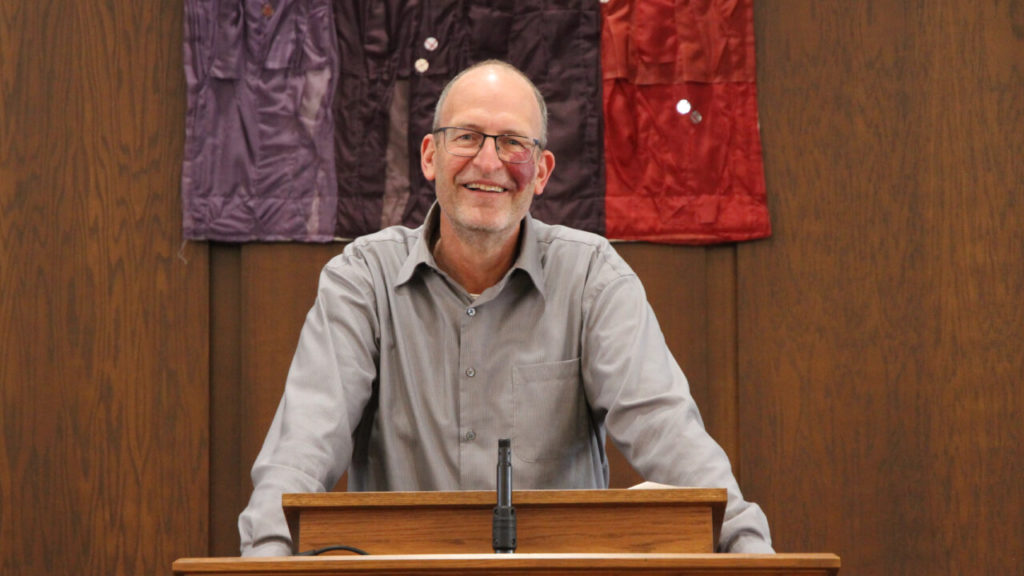
I have never preached before on Daniel and the lion’s den. The last time I remember lions coming into a worship service at SJMC was early in my time here when three guests from the Benin Bible Institute were here, and one of them did a very enthusiastic children’s story in French, that Nathan Kruger translated. Some of us are still a bit traumatized by it. The story was about a family in a little village that discovered a small injured baby lion in the nearby forest. They nursed the lion back to health right in their very home, taking very good care of it, where it grew into adulthood. One day, when the lion was out with their little boy -and here is where Nathan did not know whether or not, or how, to translate the French into the English for the very young gathered children – the lion pounced on the boy and consumed him limb by limb. This was not a Simba Disney Lion King story. Then the same thing happened with the girl, the mom and finally the dad. It got pretty graphic! There was some cross-cultural translation needed here. The lion represented sin in your life, and if you even let a little bit of sin inside, it can grow and grow and consume you from the inside. This is not where our children’s stories usually go… but it is the last lion story I remember here at SJMC! 😊
I am going to go in a different direction, but not only with the lions, but with how I usually preach. More on that in a bit. Daniel 6 is a dramatic story too. It is the follow up story to what Kandace preached on last Sunday with Shadrack, Meshach and Abednego, and like that story, an exiled Israelite, chooses to remain faithful to Yahweh, to God in a foreign land, to do the right thing and maintain his identity in faith no matter what the threat, rather than submit to a law meant to entrap him and reject his faith by bowing down to empire or other gods. Rather than a fiery furnace, it is a den full of hungry lions to which Daniel walks away unscathed, showing his trust in God. It fits into our larger Fall worship theme – When Kingdoms Fall, Hope prevails. It fits into the larger themes of exile and how to claim and live faith. Typically, that is where I would spend my preaching time – exploring larger themes, making connections, asking what we can take out of this story. That is all fine and good. But today, I want to invite us all to enter into the story in a more personal, intimate way. This is a dramatic story, a story that stands on its own, and I hope that we can get in touch with the depth of its emotions, its questions, the things we might wonder about, by stopping along the way to put ourselves into the story, and by identifying with each scene. For this sermon I am going to walk us through the story, pointing out a few things, but then after each little scene, having us take a few moments in silence to simply sit with an emotion, a question, a pondering, a reflection on what might be parallel in your life right now. This is a form of guided meditation where we put ourselves and our lives into the story and its themes. So, let us enter into the story of Daniel, taking our time to feel the emotions ourselves and ask and sit with the questions and wonderings that come out of this story.
The story begins with the 100 satraps, or provincial governors in the Persian empire, and the two other key administrators who learn that King Darius has appointed Daniel over the whole kingdom, this foreigner that had distinguished himself above all others, had an excellent spirit in him and was blameless as far as any corruption. They are instantly jealous and conspire to bring him down. Jealousy. Such a strong emotion, and uncomfortable emotion, and perhaps more than we want to admit, a common emotion. It arises out of our own insecurities or lack of control or failures. We are envious of another’s success. We hate it when others rise ahead of us. It is a part of our human condition. Let us take a few moments to simply sit with jealousy – Recall a time when you were jealous of someone else. How did that feel? How were you able to let go of that jealousy?
The story continues. King Darius is easily manipulated. They butter him up – flattery – ‘O King Darius, live forever.’ Then they trick him into establishing this law that for thirty days anyone who prays to any god or human expect the king be thrown into the den of lions. The conspirators come as great patriots, loyal to the king. As Paul Lederach writes in the Daniel Believer’s Church Bible Commentary (Herald Press, 1994, p.135) ‘Patriotism is often the refuge of scoundrels, frequently used to divert attention from unaddressed domestic problems or from international misadventures.’ Hmmm…. That quote seems very relevant today. Before King Darius thought through the consequences, the bait had been taken and the law signed and sealed. Have you ever felt manipulated by others? Have you ever been on the other side and manipulated others or ‘played the system’ for your advantage? Take a moment to bring those situations and emotions to God.
Daniel knows about the law and about its consequences. But he chooses to pray anyways, three times a day as has been his practice – privately in his own house, with its upper room windows open towards Jerusalem. Not making a big public scene, but keeping to his commitments, a form of civil disobedience. Last Sunday Kandace reflected on the theme of resistance in the Shadrack, Meshak and Abednego story. Might prayer be one form of resistance? Prayer and praise grounds Daniel as he seeks mercy before his God. Reflect for a moment on your prayer life. When do you find yourself praying? How does it help ground you? Do you ever see prayer as a political act, a form of resistance and calling on God to show up and act in our world?
The men watch Daniel pray. They have their proof. Their trap worked to perfection. King Darius is caught. The law he signed cannot be changed or revoked, according to the law of the Medes and Persians. He was determined to make every effort to save Daniel until the sun went down, but to no avail – the ordinance that he himself as King had signed cannot be changed. He is caught in legalism. There is no not-withstanding clause. His hands are tied. He has no imagination for an alternative. Take a moment to reflect on when you have found yourself caught up in a legalism of spirit that binds you to inaction and takes away the compassionate response. When have you accepted that this is ‘just the way things are’ with no imagination for an alternative?
Daniel’s fate is sealed. But we don’t hear a word from Daniel in our Scripture passage. For all we know, he could have been totally calm and trusting of God, or absolutely in terror at what was to come. The text does not tell us. The person we do hear from King Darius. He is very much distressed. As Daniel is thrown into the den of lions, he calls on Daniel’s God to save him. The King spends the night fasting and sleepless – full of fear. Reflect on what it is in life that makes you the most fearful. Is it fears for yourself, or fears for others, the people you love? Sit with those fears and offer them to God.
The dawn arises. The King hurries at first light to the den of lions, crying out anxiously to Daniel – ‘Has your God been able to deliver you?’ To his utter amazement and shock, Daniel responds. This is the first time in the story we hear Daniel speak. He too starts with deference – ‘O king, live forever.’ And then he testifies that God sent his angel to shut the lion’s mouths, because he was blameless before God and before the King. The Scripture says, ‘No harm was done because Daniel trusted in God.’ How de we respond to a miraculous story like this – it feels like a fairy tale, this saving from the lion’s den. It is unrelatable to our lives. We can easily dismiss it. In last week’s story, Kandace pointed out how the three characters did not know beforehand that they would be saved from the fiery furnace, but they were still faithful. Maybe the trust comes in not knowing the ending. What if we ask ourselves what it might mean for us to truly trust in God, in our daily lives today, without knowing how things will turn out? Sometimes bad things will happen. Can there still be trust? Maybe it is more about how we act and live, and whether we do so in a spirit of trust, following the way of God, the way of Jesus, and trusting that God will be with us, no matter what might happen to us. If we take the den of lions as representing the fears that we named, is trusting offering those fears to God? So take a moment to name areas in your life that you want to offer into the hands of God, trusting God to bring no harm, and to be with us no matter what the outcome.
In response to Daniel being saved, the King does three things, two of which make me uncomfortable, the first of which is downright offensive. These verses somehow did not make the Children’s Peace Table Bible – that ‘the king gave a command and those who had maliciously accused Daniel were brought and thrown into the den of lions, they, AND their children and their wives’, and the lions made quick work of them. Revenge and punishment are as strong as jealously was to start the story. I don’t know what to do with this, especially the innocent children and wives being included. Then the King goes on and makes a decree that all people shall tremble and fear and worship before the God of Daniel. Again, another decree that does not give freedom of choice. Isn’t this what Constatine did with Christianity in the 3rd century that has gotten us into so much trouble – forcing religion on others? I don’t’ know what to do with this either other than naming it. But there is a third thing. Through this experience, King Darius recognizes who this God is and names this for the people. ‘For he is the living God, enduring forever… He delivers and rescues and works signs and wonders in heaven and on earth.’ When it comes right down to it, that is what King Darius takes away from this experience – an encounter with the living God, a God he can put his trust in. This is his Red Thread, to use the language of our fall worship series. This is what shapes his life moving forward. This story in many ways is as much about King Darius as it is about Daniel, and about the living God he discovers. So a last time of silent reflection. Where do you recognize and experience the living God in your life right now?
We’ve come this far by faith, leaning on the Lord, trusting in God’s holy Word. Amen.