

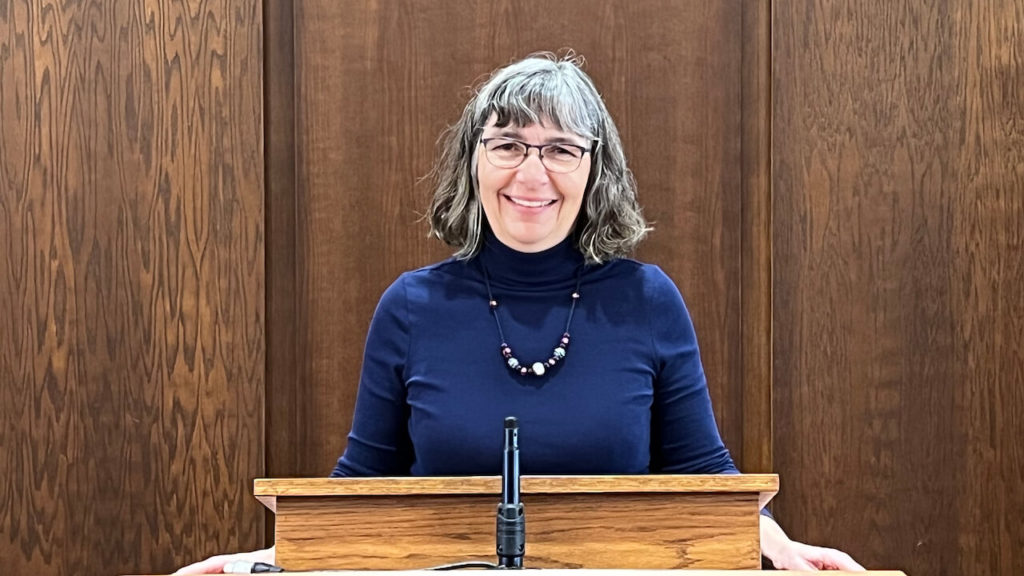
Meditation for Eternity Sunday 2025
Coming Home to God
God, you have been our dwelling place,
our refuge in all generations.
Before the mountains were brought forth,
or ever you had formed the earth and the world,
From everlasting to everlasting you are God (Psalm 90:1-2).
And it is in you we live and move and have our being (see Acts 17:28).
We all long for home–
for that sense of safety and security,
place and identity.
Like the honking of a flock of Canada geese flying overhead,
encouraging, guiding, calling out the way,
we seem hard-wired for home.
Some people like to describe it this way:
when we are born we come from our home in the heart of God,
bearing the image, the imprint of the Divine.
Fully known. Fully loved.
When we die we return to our home in the heart of God.
Fully known. Fully loved.
And in between we catch glimpses of home along the way.
We have moments, in those “thin places,”
when the veil between this world and the next seems particularly porous,
When we are reminded of what it feels like to be at home in the heart of God.
Life has its busyness and its distractions,
its challenges and struggles.
It is so easy to forget what home in the heart of God feels like.
The homes we enjoy here on earth fill some of that need to feel at home.
But of course none of us had a perfect home,
or created a perfect home.
We are human after all.
So somewhere in our hearts there remains a spark, a memory, a longing,
a desire for that sense of home, where we are fully known, and fully loved.
Poet William Wordsworth (from Ode on Intimations of Immortality From Recollections of Early Childhood) describes it this way:
Our birth is but a sleep and a forgetting;
The Soul that rises with us, our life’s Star,
Hath had elsewhere its setting
And cometh from afar;
Not in entire forgetfulness,
And not in utter nakedness,
But trailing clouds of glory do we come
From God, who is our home:
Heaven lies about us in our infancy!
Our birth is but a sleep and a forgetting;
This poem excerpt reminds me of a delightful story. A young child approaches the crib of a newborn sibling. Looking with wonder at the face of the beautiful, innocent baby, the older child whispers to the infant, Please, can you remind me what heaven is like? I am starting to forget.
We all long for home–
a place to feel safe and secure,
where we find comfort and care,
where we are nourished and nurtured,
where we belong,
where we are seen and heard,
known and valued,
where we are loved,
where we can be ourselves,
where our emptiness is filled,
our longings are satisfied,
where we can release the burden of our grief and pain,
where we find peace and rest from the storms of life,
where we can commune with the author of life and love.
We all long for home in the heart of God.
There is much that can interfere with our homing signal.
There are lots of obstacles and barriers that obstruct our path home to God.
There are distractions and attractions that compete for our attention,
until, like that young child, we start to forget what home was like.
We lose our way or take another path
that leads somewhere other than home.
The Scripture we read today from Ezra tells the ancient story of a people
exiled from their land and their place of worship for generations,
who finally have the opportunity to return home and rebuild.
There is rejoicing and singing as they make their way home.
We’re marching to Zion, beautiful, beautiful Zion (VT 31).
They are so excited to return to their treasured land–
a place that shaped their identity as a people, sustained their life
and gave them confidence in their God.
The young ones who have never seen Jerusalem–their eyes light up with anticipation, for they have heard the old stories.
And the old ones who remember that glorious city and its holy temple
long to lay eyes on it once again.
It’s a homecoming filled with hope and joy and excitement!
There is a stirring in their hearts.
They gather supplies for the journey.
Their neighbours send them on their way with gifts and good wishes.
They carry with them the sacred objects that had been taken from the temple.
And once they arrive, there is much to be organized.
Everyone has a job to do in the rebuilding.
But, sadly, in reality, it is only a remnant of the people that return.
Not all find they have the desire or the strength to return home and rebuild.
They have different lives now.
So much was damaged and destroyed.
So much was lost.
Too much trauma lingers.
They can’t go back there any more.
And the work is slow.
It takes years just to lay the foundation stones.
And while some shout and sing with rejoicing
others–the old ones–weep for the sadness of it,
for it is nothing like it once was.
What a striking image! Rejoicing and weeping mingled together.
Can we relate to this exile and homecoming journey?
Certainly we can relate to the longing for homes that are safe and secure.
Homes where we can be ourselves, where we can thrive.
As one biblical writer put it,
They shall all sit under their own vines and under their own fig trees,
And no one shall make them afraid (Micah 4:4).
We also know what it is like to live through seasons of uncertainty.
We know the pain of loss–sometimes losses that come in bunches,
and turn our lives upside down.
And we can relate to the weeping and the rejoicing mingling together,
especially when we have lost a loved one to death.
We are caught up in both the grief for what we have lost
and our gratitude for the memories.
While we weep for the way things used to be
We know there is no going back to the way things were.
It will never be the same,
for death and loss leads us into new territory–
terrain we have never traveled before.
And we know how hard it is to start over again after a loss,
after our lives have been touched by grief.
We understand what it means to wonder if we have the energy and hope
to pick ourselves up and move forward.
And some of us know what it is like to long for home–our heavenly home
We wait, weak, weary and wondering when it will be our time to go.
This story from Ezra is part of a much bigger story,
And a much bigger story line. A thread.
A red thread that weaves its way through the whole story
that affirms and assures us that we are not alone.
God is with us in whatever we experience or encounter in this life.
God’s steadfast love endures forever (see Psalm 136).
The bible is a whole library of stories that insists we are not alone–
that assumes love is stronger than our fears.
When death and loss come to us and come for us,
even then we are held in the embrace of God’s love,
God’s chesed–that steadfast, faithful, tenacious solidarity.
There is a love that will not let us go.
God walks with Adam and Eve in the garden, in the evening.
Abraham counts the stars and can’t comprehend the fulness of the promise for his descendants.
Hagar sees the very face of God in the wilderness when she fears for the life of her only son.
David in the wilderness, on the run for his life, pours out his heart to God, and finds protection.
A woman at the well, exiled by her community, finds courage to share the good news that she found one who offered living water.
A lost sheep is found. A prodigal son finds his way home to the heart of his father.
Friends on the road to Emmaus recognize Jesus in the breaking of bread.
Over and over again the story affirms that the call to love overcomes our fear
But that’s not all.
Over and over again,
in story after story
God promises to make things new.
God is always ready to start over,
always ready with another chance.
Forgiving, restoring, mending, fixing.
God promises that even when the worst thing happens
something new is possible one day.
This death and resurrection theme is at the heart of the Big Story.
It is at the heart of the gospel.
The Psalmist writes:
When the Lord brought back [the] exiles to Jerusalem,[a]
it was like a dream!
We were filled with laughter,
and we sang for joy.
And the other nations said,
“What amazing things the Lord has done for them.”
Yes, the Lord has done amazing things for us!
What joy!
Restore our fortunes, Lord,
as streams renew the desert.
Those who plant in tears
will harvest with shouts of joy.
They weep as they go to plant their seed,
but they sing as they return with the harvest (see Psalm 126).
I found a poem by Jan Richardson that explores this upside-down theme of new life out of death.
Blessing to Summon Rejoicing
When your weeping
has watered
the earth.
When the storm
has been long
and the night
and the season
of your sorrowing.
When you have seemed
an exile
from your life,
lost in the far country,
a long way from where
your comfort lies.
When the sound
of splintering
and fracture
haunts you.
When despair
attends you.
When lack.
When trouble.
When fear.
When pain.
When empty.
When lonely.
When too much
of what depletes you
and not enough
of what restores
and rests you.
Then let there be
rejoicing.
Then let there be
dreaming.
Let there be
laughter in your mouth
and on your tongue
shouts of joy.
Let the seeds
soaked by tears
turn to grain,
to bread,
to feasting.
Let there be
coming home.
—Jan Richardson
from Circle of Grace: A Book of Blessings for the Seasons
Our home is in the heart of God
Always and forever we are called back to that home.
Softly and tenderly…beloved come home (VT 544),
to the heart of God,
which is mercy and love overflowing.
So as we light our candles today
and we name our grief and our pain–
name our loved ones who have gone home to God,
may we trust that there is comfort to be found in the heart of God.
And may we do so with hope through our tears,
responding to the promise that even in the valley of the shadow we are not alone.
Even in death God is making all things new.
We will tell those stories of the Advent of the good news starting next week:
A shoot shall come out of the stump of Jesse…(Isaiah 11:1)
A young woman shall conceive and bear a son…(Isaiah 7:14)
The dawn from on high will break upon us…(Luke 1:78)
The people who walked in darkness shall see a great light…(Isaiah 9:2)
The light shines in the darkness, and the darkness has not overcome it (John 1:5).
A grain of wheat falls to the ground and dies, if it dies, it produces much fruit… (John 12:24)
And, in the words of Jesus, I am the resurrection and the life. If you trust in me, even though you die, yet shall you live ((John 11:25).
Thanks be to God! AMEN.