
This summer has been all about stones and rocks. Yes, in our summer worship series, and we will get to that. But also, for me, in my camping vacation time. Rachel already referenced one of the campgrounds we went to this summer. In August, we had a 2-week Northern Ontario camping trip, with a few days in Quebec as well. We camped at Samuel de Champlain, Opemican in Quebec, Chutes and Grundy, and I had a solo wilderness overnight on the French River. It was wonderful, and all of it was in the Canadian Shield – that massive ancient geological covering of roughly half of Canada’s land mass – as the 1999 Arrogant Worms song that speaks of Canada ‘we’ve got rocks and trees, and trees and rocks, and rocks and trees, and trees and rocks, and rocks and trees, and trees and rocks, and rocks and trees, and trees and rocks… and water.’ I absolutely love that Canadian Shield geography, and was particularly struck again by all the rocks! I know there is a whole bunch of SJMCers over the years that have fished on the French River, and now I know why, with my first extended time there, paddling along constant rock formations on both shores. It is breathtaking. And No, I didn’t fish. Rachel and I also spent one day in Sudbury at Dynamic Earth, where you see the Big Nickel, and we did the underground mine tour with rock all around us, imagining the challenging life for those early miners as they spent their hours underground, in rather unsafe conditions, mining the rich minerals beneath. We also did the rock polishing, where you get 3 very rough stones each, and slowly polish them down and shine them up, until their shiny beauty emerges. It is a great image for life itself, and Mildred referred to precious stones already this morning.
And then there was Samuel de Champlain, the rock labyrinth, and the devastating microburst last June 21st. I have mentioned this campground story before. We went to a program with a Park Ranger telling the story. It was early evening after a humid day. About 100 campers were making supper or relaxing, when what first felt like a typical thunderstorm quickly escalated into a violent downburst – in about a minute 100 millimetres of water came straight down on the Jingwakoki Campground, where we always camped, followed by winds of up to 200 kilometers an hour – that hit the ground and then fanned out, spreading destruction outward, instantly flattening thousands of trees, blocking roads, downing power lines, destroying tents and trailers and vehicles and trapping campers. Amazingly, no one was killed. In the year of clean up, they trucked out 300 semitrailers of chipped wood and thousands of what became telephone poles Rachel and I knew we needed to camp there this year, in the remaining Babawasse campground, only partially hit – almost as a form of therapy, healing. I kayaked Moore Lake the first evening, taking photos of the destruction. The campground. The beach. Yup, swim at your own risk… It was sobering and sad. And yet, there was still a sunset that evening, and the loons sang and the beavers swam, and bird songs could be heard everywhere. The Ranger brought us to a flattened area of the camp, and we spent time looking at all the many plants and shrubs and trees that have exploded in growth because they now have sunlight again. Fireweed and many other plants and new saplings. As he said, ‘nature is not sentimental.’ It is not static or bound. It recovers, it moves on, it springs forth again with new life – much of which is only possible after destruction by wind or fire. Nature would be okay.
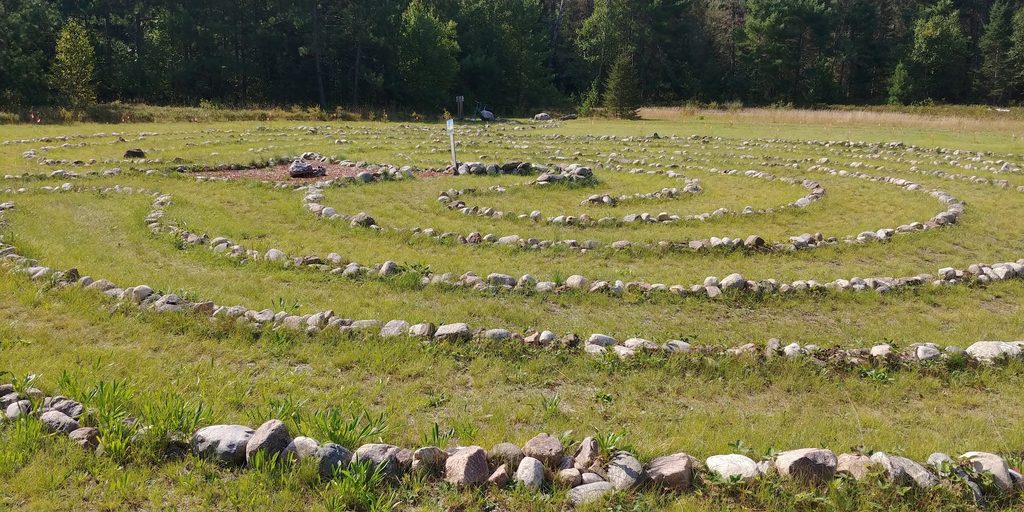
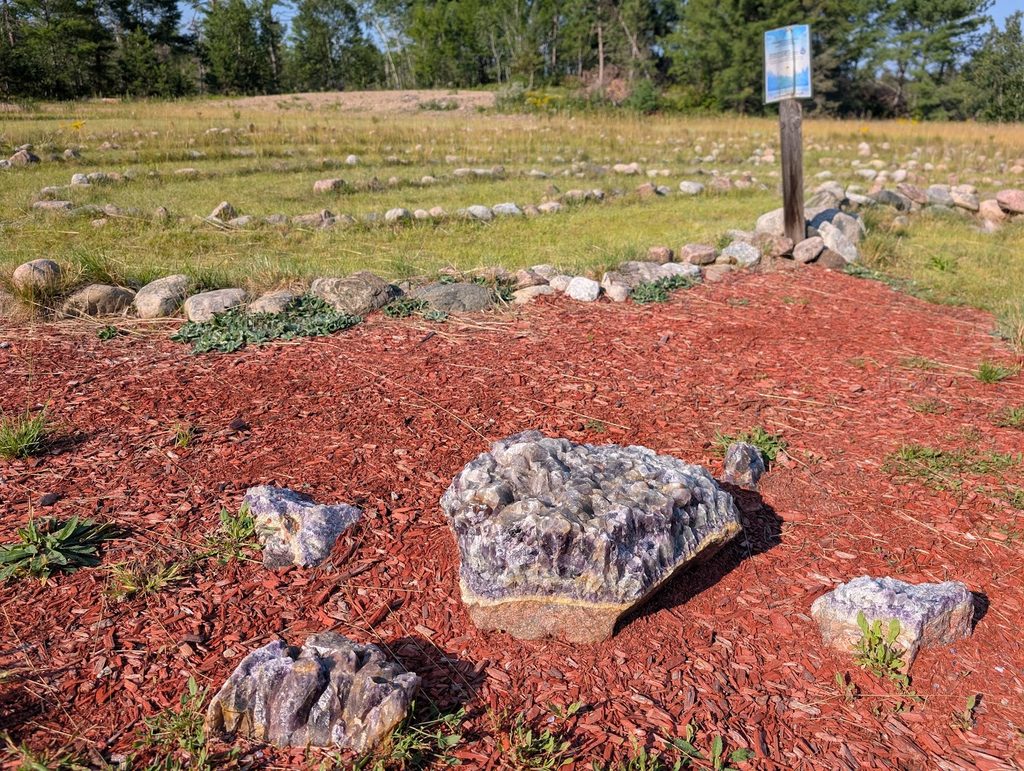
And we walked the labyrinth, as Rachel described so beautifully. In 2018 we had walked the original labyrinth in the Chartres Cathedral in France, with its weathered stones. Now, at Samuel de Champlain, we took off our shoes again. We picked up a rock in our hand. We slowly wound our way to the centre, to the amethyst rocks. We each did this on our own, in our own time and space. Each time, I found myself humming and then singing out loud a Psalm 5 camp song – Give ear to my words O Lord, consider my meditation – a song that centres me, and a song I sang at the funeral for Bryan Schroeder Kipfer and has stayed with me all summer. There was something about holding that rock, bringing it to the centre, and then dropping it off at the end, that gave me hope, that lifted my spirits, that allowed me to let go of the destruction I had observed at this campground, and have trust. It was Holy Ground and these were living stones!
Today is the last Sunday of our Stepping Stones worship series. We have emersed ourselves in stories of stones and rocks, from the Biblical text, and from our lives. The personal stepping stone stories have been profound living stones! It feels like the opening Reader’s Theatre and today’s Scripture from 1 Peter are a kind of summary, a capstone, of the whole summer. Almost all the images are there. I love what the author of the Believers Church Bible Commentary on 1 Peter says about this passage (1-2 Peter, Jude, Erland Waltner and J. Daryl Charles, Herald Press, Waterloo, Ontario, 1999): ‘Fluidity rather than precision mark his use of images (p.73)… and… His generous, free – and even audacious – use of biblical imagery portrays powerfully the flow of God’s redemptive and reconstructive purposes. (p.79)’ It’s more a flurry of images and impressions. Come to the living stone, chosen, precious, spiritual. Stones that are rejected but become the cornerstone, but also a stumbling block. What do these stones mean? And then this marvellous passage about being a chosen people, a royal priesthood, a holy nation, God’s own people, called into marvelous light. Once you were no people, now you are God’s people; once you had no mercy, now you have received mercy. There has been a trajectory in this passage but also in all of Scripture itself from solid, immovable, trustworthy, hard stones, to dynamic, flexible, breathable, living stones, full of mercy and new life. And maybe that it the key insight, and the key image. Stones that have become living. Lives that become their own living stones, both as individuals, but even more as communities, as God’s own people. From temples and buildings to the people themselves.
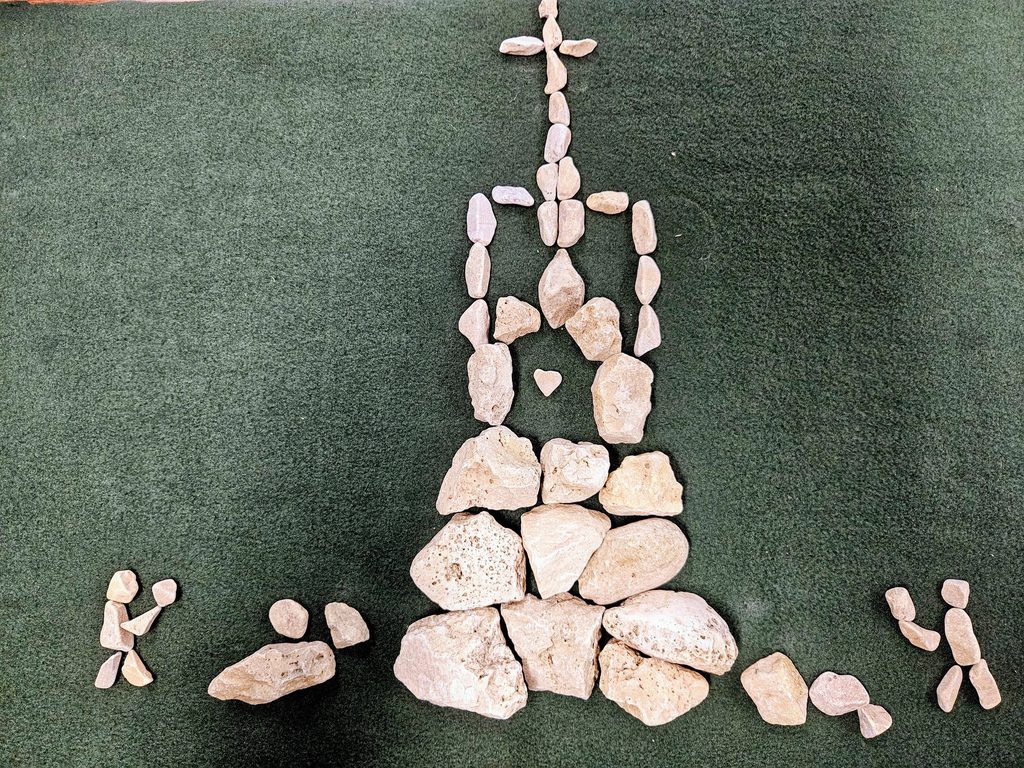
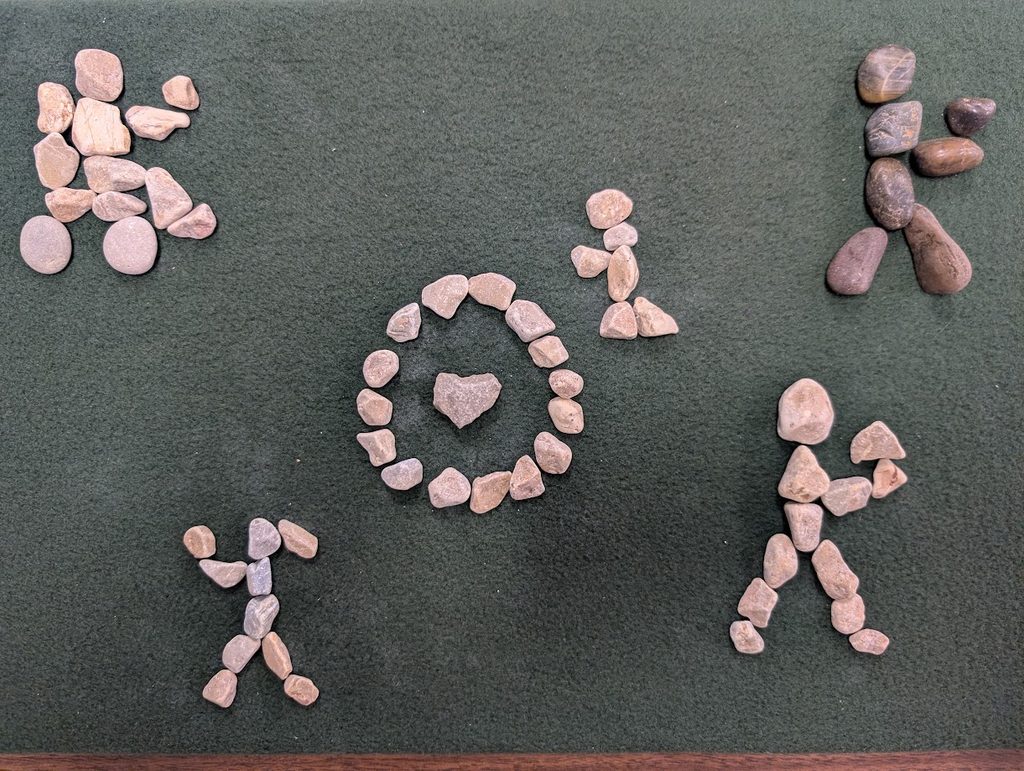
At our pastoral team meeting this week, Janet and I were talking about this passage of Scripture, and about the rock art that has been created by several of you this summer. Janet got inspired, and she put together her own rock art for this particular passage. She did two. She perfectly captures this passage, and really the trajectory of our whole summer.
Here is the first version. What I see is a temple made of stone, lifting up into the air. It is solid and reliable, with a good foundation. Maybe there is even a cornerstone. There is value here, meaning, tradition. People are drawn to it. Notice the heart at the centre. I like the cross at the top. People are coming to temple, the structure, the gathering place, each holding their own rock. Our cathedrals and churches have been physical dwelling places for God, and we as individuals and communities have also been invited to be temples of the Holy Spirit, witnessing to God’s presence. I also notice a few cracks, and some rocks that have crumbled over on the sides. Does there need to be some shifts and changes? Some people also carry baggage with the temple, the church, the institution. There is hurt, disillusionment, frustration. I think about the stumbling blocks Amanda shared in her sermon in early August. But there is lots to keep here too – the value of our traditions and faith heritage. We have been that living temple.
Here is the second version. There is no big structure here. There is a move away from the static, immovable rock, walls, temple, and what has replaced it are living stones, and stones placed in a circle, like a campfire. A whole diversity of people is gathered around. There is a heart stone here too, right in the centre. I am personally reminded of Jaren Klassen’s baptism last week around a campfire circle at Conrad Grebel, with Ontario Mennonite Music Camp and his home congregation of Bloomingdale Mennonite there – faith formation looking a little different and taking on new life. It is people, not structures or buildings or systems or dogmas. Notice that each person is still carrying a stone, carrying something of value from what has been and giving it new meaning. It is new hope after something has crumbled. It is new life emerging and growing up after a microburst, after destruction, because you can see the light again. It is gathering around a circle. Living Stones! (Photo Blank)
We are living in a world and a time when it feels like much is crumbling and falling apart around us. The foundations are shaking, of society, of trade and commerce, of common assumptions and values, and of church. And maybe that is normal and healthy, or at least, not something to destroy our faith and trust in the God who calls us to be living stones. Like Samuel de Champlain, new life can and will emerge. Maybe it is not being so sentimental about the past, but rather recognizing its beauty and value, and that we still will carry those rocks with us, but also being open to what new might emerge, beyond what we can imagine.
Christian thinker Brian McLaren, writes about the Temple in his book ‘The Great Spiritual Migration’ (Convergent, New York, 2016), using the story from the gospel of John of the cleansing of the temple. He writes that ‘the story offers deep meaning for all of us who are sifting through the rubble of collapsed systems of belief, wondering if anything of value will remain… Jesus is making a revolutionary proposal: the Temple could crumble. It could pass away, and its collapse wouldn’t be the end of the world…. Something better would rise from the rubble: a system of extravagant and generous grace, open to all people… a more human, loving, embodied way of relating to God, self, one another, and all creation…. I could no more imagine my Christianity surviving a collapse of my belief system than Jesus’ contemporaries could have imagined their religion surviving a collapse of their Temple… even if the worst imaginable thing happens, even if our traditional religious architecture crumbles – physically or conceptually – even then God can raise something beautiful from the rubble. The end is not the end. It’s actually the doorway to a new beginning.’ (p.26-28)
When it comes down to it, it really is all about what is at the centre. It always has been. It is about heart stones, about centering our lives on Jesus. ‘Come and find the quiet centre, in the crowed life we lead, find the room for hope to enter, find the frame where we are freed.’ (Come and Find the Quiet Centre, United Church Hymnal #374). What do these stones mean? Come to him, a living stone, and like living stones let yourselves be built into a spiritual house, for once you were no people, and now you are God’s people. Once you had not received mercy, but now you have received mercy. (Amen…or Sing)
Give ear to my words O God. Consider my meditation. Hearken unto the voice of my cry. My king and my God. For unto thee will I pray. My voice shalt thou hear in the morning. O Lord in the morning, will I direct my prayer, unto thee and will look up.’ Amen.