
Since near the end of May, it feels like all I, all we, have been doing is marking various milestones. Late spring tends to be the time in our SJMC worship cycles that we do lots of milestones and rituals. That is normal and good, but this year, it feels like it has been more than ever. This has spilled over into other areas of my life as well. Just think back first to our Sundays in worship. On May 24th, Pentecost Sunday, we marked the 10-year milestone of our LGBTQ Welcome Statement and included a whole powerful ritual of dropping stones into a glass bowl – what do these stones mean? On May 31st we welcomed 4 new members into our congregation, and they signed our SJMC Covenant. On June 7th, out at Hidden Acres Camp, we had the ritual of baptism for Ana Joy, with the symbols of butterflies and the baptismal waters of the pond. On June 14th, we held babies and blessed them, and gave out certificates and candles. These were all powerful experiences of worship as we marked all these milestones. In June, I also officiated at 2 Saturday weddings, and attended a 3rd Saturday wedding as a guest, as family. I officiated at 2 funerals – very different from each other – that of Doris Kramer, our oldest member, with its themes of heart stones, as we heard again this morning from Stephanie, and the tragic death from cancer of Bryan Schroeder Kipfer last week. There were also some personal milestones – My birthday was June 15th – there are 6 June birthdays in our broader family, and Rachel and my 34th Anniversary was yesterday. We simply ignored Father’s Day – it’s all just too much! A few weeks ago, I gathered with a number of pastor friends for a BBQ to mark both one pastor retiring and moving to K-W, and another pastor couple, where both have retired and are moving to Winnipeg. It was bittersweet as we signed cards and spoke words of blessing. That is a lot of milestones, all in a short time period, each with their own unique meaning and rituals and symbols.
Our scripture this morning from Joshua, has helped me step back and take stock of all of these milestones, and ask some good questions about why we do them, how we do them. and what is their meaning and significance. As the people of God prepare to cross the Jordan River, Joshua sends 12 people to the riverbed to gather 12 rocks, one for each of the 12 tribes of Israel. They bring the rocks to the camp, and pile them up in a stone memorial after the miraculous parting of the waters to cross the river. This was a huge milestone for the people of God – a milestone 40 years in the making as they finally crossed the Jordan River into the Promised Land after 40 years of wandering in the wilderness. This is the culmination of a long hard journey that began with the Exodus from Egypt as slaves, with years of leadership from Moses before he dies, and finally ends in this crossing, led by Joshua. This is an occasion that needs to be marked, needs to be ritualized in some way, needs to be remembered by future generations – when the children ask.
There is lots we could ask about the rest of the book of Joshua, and what it means to possess a land, and dispossess those who are living there, or how this book has been used to justify all sorts of other stories of conquest over the centuries, including with First Nations here in Canada. But that is a different sermon for a different day. We have wrestled with this on other Sundays and will do so again. For today, we will stay with the theme of milestones, and the meaning of these stones.
There are some things I notice about this story. The first is that this is a significant event, worthy to be marked, memorialized. There is meaning and significance. There is story. This is when you mark something. As Brent said in his opening, there is a time before and a time afterwards – a separation – life will no longer be the same after crossing the river. It’s about transitions. The late Old Testament scholar Walter Bruggemann, in his book The Land (Fortress Press, Philadelphia, 1977), writes about this shift for the people of God. For 40 years they have been landless and lived by Promise, by relying on God for their very survival, for the Manna that fed them, and now Land comes as a Gift. But Land can soon become Problem instead of Promise. There is the temptation to forget, for guaranteed security to dull the memory, to be seduced into thinking that they themselves are in control. Then one forgets compassion and mercy and justice. One reason we mark milestones is so we don’t forget, forget the meanings, forget the reason something happened in the first place. We can always go back to that marker, that milestone, that original story and meaning.
Brent named a number of different kinds of milestones – First day/Last day of school, baptism, marriage, having children/grandchildren, first day/last day of work, Significant losses, death, and we could add many more. Think about the most recent milestones in your life? Why is that event significant to you? How did you mark it? Why did you mark it in some way? Did that help you live by promise? Did you reflect on the role of God within that life event? Or did it go by almost un-noticed and you wish you had taken the time to mark it? Is there a temptation to forget, to miss the meaning of that moment, to dismiss it, and by doing so, lose both its significance and its gifts to you?
What about some of the events we don’t mark? Perhaps those that are more uncomfortable or painful. We don’t often have rituals for a divorce, or family estrangement, or a miscarriage, or the unwelcome loss of a job or forced retirement, a change in one’s name – how you want people to identify you, a geographical move or downsizing, or a health issue that has changed how are you able to live one’s life. These are certainly moments of much significance and meaning, often very hard; there is separation and life in no longer the same afterwards; and yet these are harder to find words for, harder to ritualize or mark as significant milestones, where publicly or privately – in smaller groups. Could this be a place of imagination? A place where the church could help people name and mark those significant events too?
A second thing I noticed in our Joshua Scripture, is that there is some story telling that happens, that names what the meaning of the milestone is. This is a public story telling – a speech in this case. Joshua speaks to the gathered community – when your children shall ask in times to come, what do these stones mean, you shall tell them – that the waters of the Jordan were cut off in front of the ark of the covenant of the Lord, that the Lord your God dried up the waters of the Jordan… just as God did to the Red Sea back in Egypt, so that all the peoples may know that hand of the Lord is mighty and you may worship God. It is about what God is doing. This is the meaning of the stones. Remember that.
As I mentioned, I have been present at both several weddings and funerals in the last month or so. They are very different kinds of events, with contrasting emotions. And yet, with both of these, one of the key elements is telling the story, making speeches. I was surprised by how good the speeches were from the wedding parties in the weddings I was at – something with the potential to be sappy and overly sentimental. There was a real acknowledgment of the value and strength of relationships, the sharing of good times and hard times, and the unique gifts and blessings of those being celebrated. They named meaning and significance. That was so true at the funerals too, as people shared their tributes, and their love. Thank you Stephanie for sharing this morning some of this significance through the heart stones. It is important for things to be said, for what gets spoken publicly in our milestone moments – for there to be both honesty and grace. Even in a funeral as sad and hard as Bryan’s the tributes, done so sensitively and from the heart, were so important in the grieving process, as was the whole ritual of a funeral, of gathering as a people to share our love and support. As a pastor, I see my role in a wedding or a funeral, a baptism, a child blessing, as placing those lives, those stories, those individuals within the larger story of God – the story within a grand story.
Amy Davis Abdallah wrote a book called Meaning in the Moment – How Rituals help us move through joy, pain, and everything in between. (Brazos Press, Grand Rapids, Michigan, 2023). She reflects on both church and personal rituals, another word for milestones. She names many of our common milestones, but also those we tend not to know how to mark. She also names the power of naming what is going on, telling the stories. At the same time, she also names the power of mystery. She writes that ‘the mystery in ritual is at least partially because rituals communicate meaning, not information.’ (p. 21). I like that. We are bombarded with information in our digital age. It is meaning that we long for, significance – reflection on that which is mystery, that we can’t fully understand, and yet we somehow grasp with ritual, with the marking of milestones. She continues ‘Some things just cannot and should not be rationally explained. At times we explain too much, acting as if we are solely rational beings. The nonrational mystery meaning is part of the beauty and transformative power of ritual.’ (p.21)
The last thing I notice about our Scripture, is that there is a physical representation of this milestone. Joshua creates a stone altar with 12 massive stones – it says that they were carried on shoulders – they were heavy. The physicalness of this is important. There is something to see and feel. There is something left that will perk the interest of the next generation – so that the children will in fact ask about it. It is like the Inuksuk’s that Brent talked about. You see that large Inukshuk in front of our church and it begs the question about its meaning. There is something about the very physicalness of milestone that makes a difference.
And so, we have wedding rings and stone markers, candles, plaques, diplomas, tattoos, certificates. We plant trees. We pick up stones and ask about their meaning. The very physicalness is important.
Anita Schroeder Kipfer shared the story in her tribute last Sunday about how Bryan’s wedding ring was sucked off by a calf 17 years ago in Manitoba and never replaced. After their wedding anniversary in June, in the Listowel Hospital, Bryan decided he needed to order a replacement ring, now, to show how much he loved Anita and his family. Anita picked up the ring just before the 5 pm closing time the afternoon before he died, and he was wearing the ring as he took his last breaths the next morning. That physical ring carries so much meaning, and was now on a chain around Anita’s neck.
Amy Davis Abdallah writes that ‘because God took on flesh – God became human – all of our humanity became holy. Because God united with a human body, human bodies are now allowed to enter God’s eternal presence…. God in humanity. God in us. Like Jesus, every moment of our lives is holy. Our bodies are holy. Our life events are holy.’ (Ibid, p.10) We are physical beings, and so often, it is by using physical images, symbols, of bodily rituals of some sort, we open ourselves to meaning, significance, mystery, understanding.
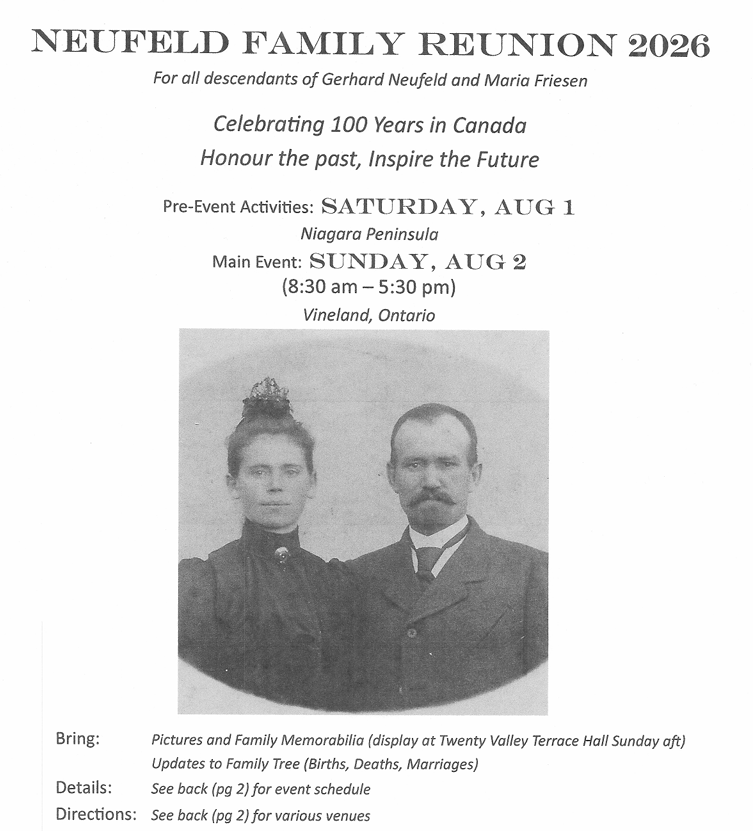
Our family will be in Vineland for the upcoming August long weekend, for what’s informally being called the Neufeld Fest. (Photo 1 – Neufeld Reunion Poster) It will be 100 years since my Neufeld family immigrated from Ukraine/Russia to Canada, and there will be over 130 descendants of my great grandparents Gerhard Neufeld and Maria Friesen at this Neufeld Family Reunion. This is a real milestone, and it all of a sudden came to mind in the middle of my sermon preparations. How does one mark 100 years? What are the ‘stones’ that have been left that can help us, several generations later to ask ‘What do these stones mean?’ What might my children ask about their family history? What physical representations will we experience that will help us mark this anniversary? (Take Down Photo and Leave Blank)
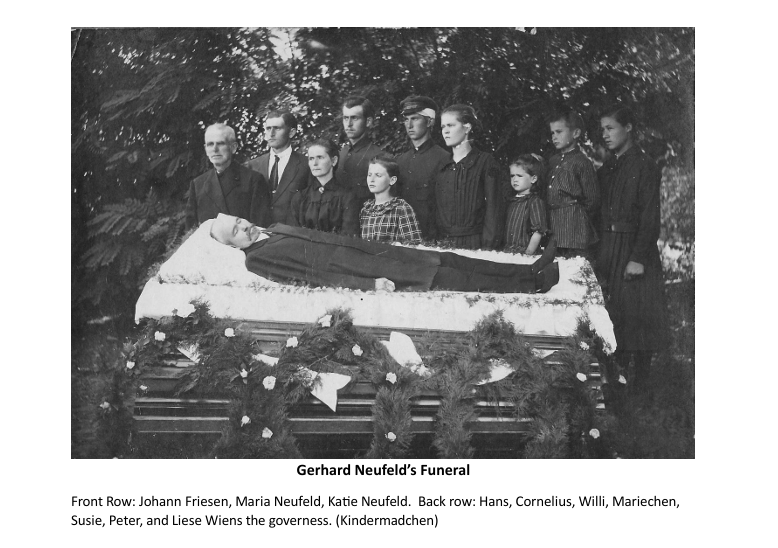
A central story to be told and remembered is one of family tragedy and trauma in the midst of the turmoil of the mid 1920’s, after years of civil war, World War I, early Stalin, and famine. The Neufeld family was preparing to leave Russia for Canada. On the night of July 16, 2026, one hundred years this Thursday, and after selling their farm and possessions, a group of 5 men, bandits, attacked and knocked out one of the brothers on the front porch and through the window shot the father, Gerhard, my great grandfather, through the chest and lung, and he died 14 hours later. A few weeks later the family continued to Canada without him. (Photo 2 – Family Photo around casket) Some of you seniors will remember the Seniors Group trip to Doon Pioneer Village in Kitchener several years ago, when I saw this photo in a display on refugees, and I kind of mocked that Russian Mennonite tradition of taking family photos of open caskets with the person who had died… that was until I read the accompanying story and all of a sudden blurted out in recognition – ‘That is my great grandfather!’ My second cousin Dave Neufeld worked for the Museum and must have drawn on this story in the temporary display. I remember sitting out in the Niagara on the Lake orchards as a youth and listening to my Opa telling us that story from his perspective as a late youth watching it all. The tragic story lived in my imagination. Yet I am glad that even this tragedy has been marked and remembered, and given meaning.
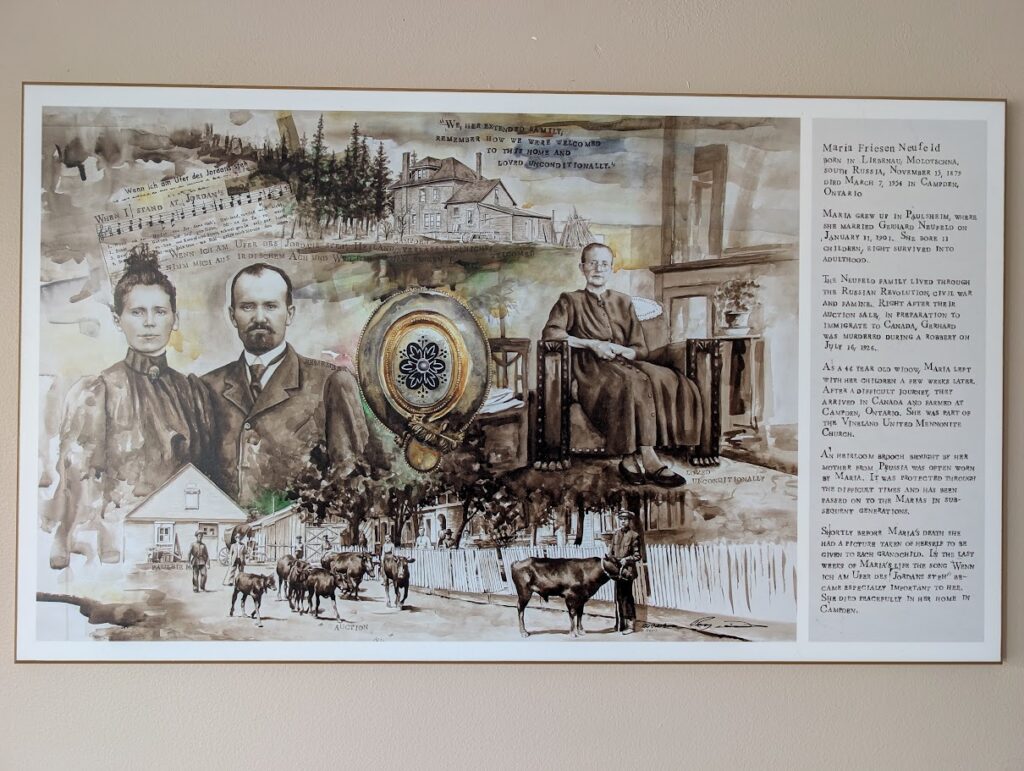
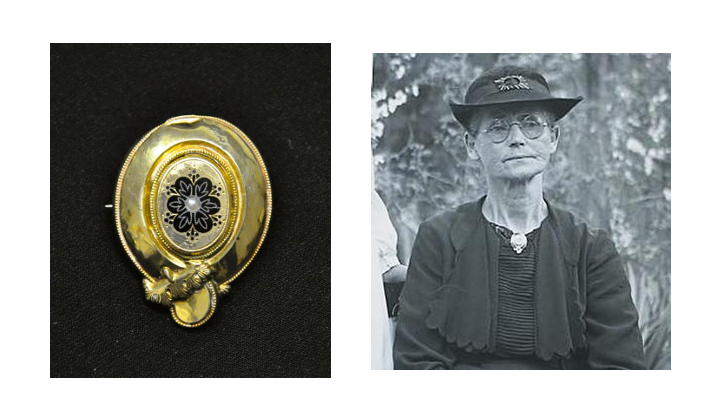
(Photo 3 – Along the Road to Freedom Art Piece) It was really only a few years ago that I thought more about his wife, Maria, my great grandmother. She was the one who had to go on, leave her husband’s grave, leave her homeland with all these children, and lead her family. She had also had a baby born and died and buried about 6 months earlier. A few years ago, her story was featured in an exhibit with art pieces called ‘Along the Road to Freedom – Mennonite women of courage and faith.’ What must her life had been like? (Photo 4 – Brooch and photo of Maria) There was a brooch, estimated at over 180 years old, that she managed to bring to Canada without selling off, that she wore on special occasions and lives within family lore, and is seen to represent her determination, endurance and strength.
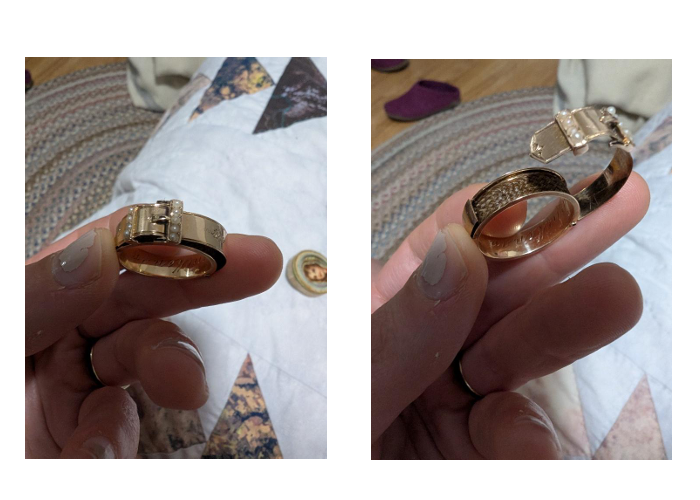
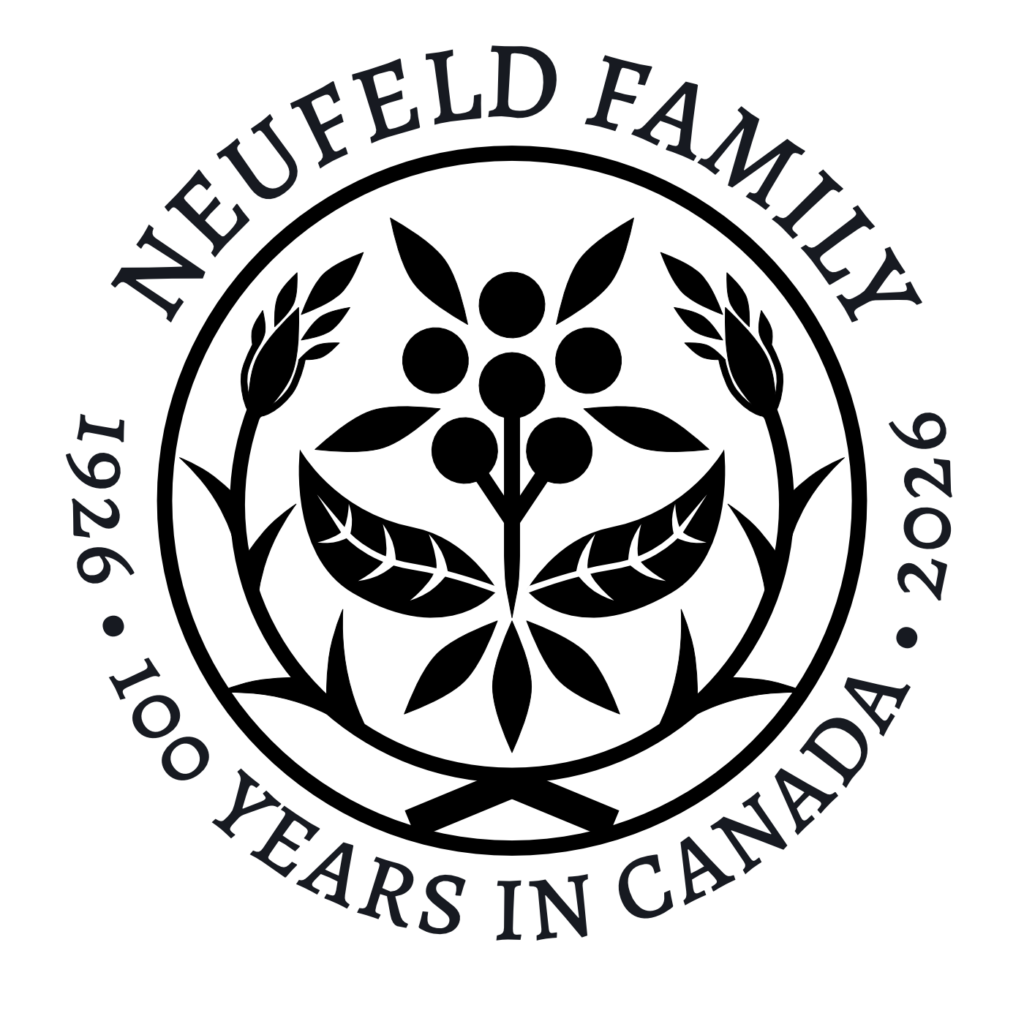
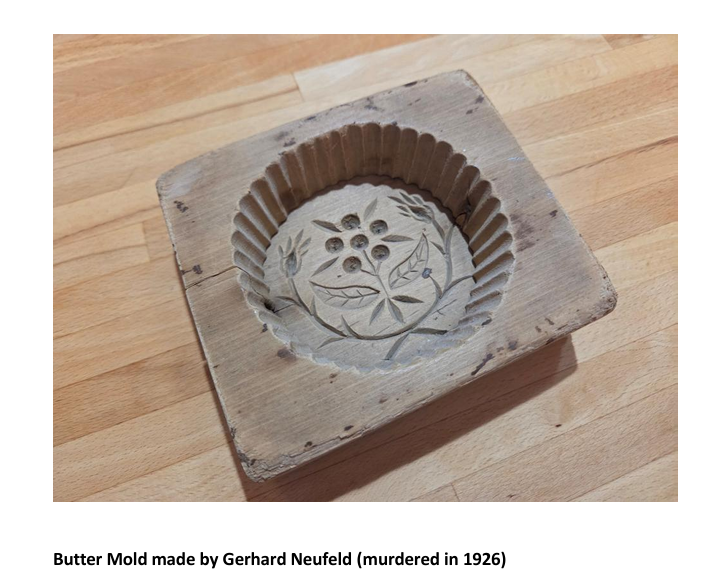
In the lead up to the reunion, there has been a large shared Google drive with all sorts of stories and photos and images, to prepare us to remember and reflect. (Photo 5 – Friesen Mourning Hair Ring) There is a Mourning (m-o-u-r-n) Hair Ring passed along from the Friesen side of the family, with a transcription “In Remembrance of C.F., a Catharina Friesen, the first wife of a Jacob Friesen, who died in 1808 after 6 ½ years of marriage – with a lock of her hair, over 200 years old, still inside the delicate inner panels that pull back on the ring – a ring that has been passed on through the Catharina’s or Katie’s in the family, including my Opa’s sister Katie who brought it to Canada, then to Kathy Dyck Rempel and then to Katarina Neufeld in 2025 at a smaller Neufeld reunion at Luther Village where I first heard about, and saw the ring. (Photo 6 – Neufeld Crest/Logo) And of course, we had to order Neufeld t-shirts, with a Neufeld crest designed by my cousin’s son in Edmonton. (Photo 7 – Wooden Butter Mold) I learned that my Great Grandfather Gerhard was a woodworker and hand crafted a wooden butter mold with this Neufeld logo that was used to press and identify their butter as it was sold in the market – both in Russia, but also for decades in St Catharines – which has had a Neufeld booth to this day. How cool! It feels like through this Neufeld Fest, I am learning more and more of my own history and family legacy. (Take Down Photo and Leave Blank)
The schedule of the weekend will include tours of some original farms and houses and cemetery in Vineland and Campden, a Sunday morning worship service of remembrance and song, a group photo, a hayride, and campfire and a Faspa potluck. In the midst will be lots of storytelling and conversations and renewing of relationships. What do these stones mean?
Thanks for indulging me with some Neufeld history. But it is an example for me of what this Sunday is all about – marking milestones, telling stories, asking questions, being reminded of meaning and significance through concrete physical items, and seeing how God is present right in the midst of our milestones, our rituals. What are the milestones in your life right now? How are you marking them? How are you entering into both their mystery and their meaning? May God’s Spirit guide you. Amen.